MEP Coordination Examples: 5 Things to Check in Vendor’s Samples


Table of Contents
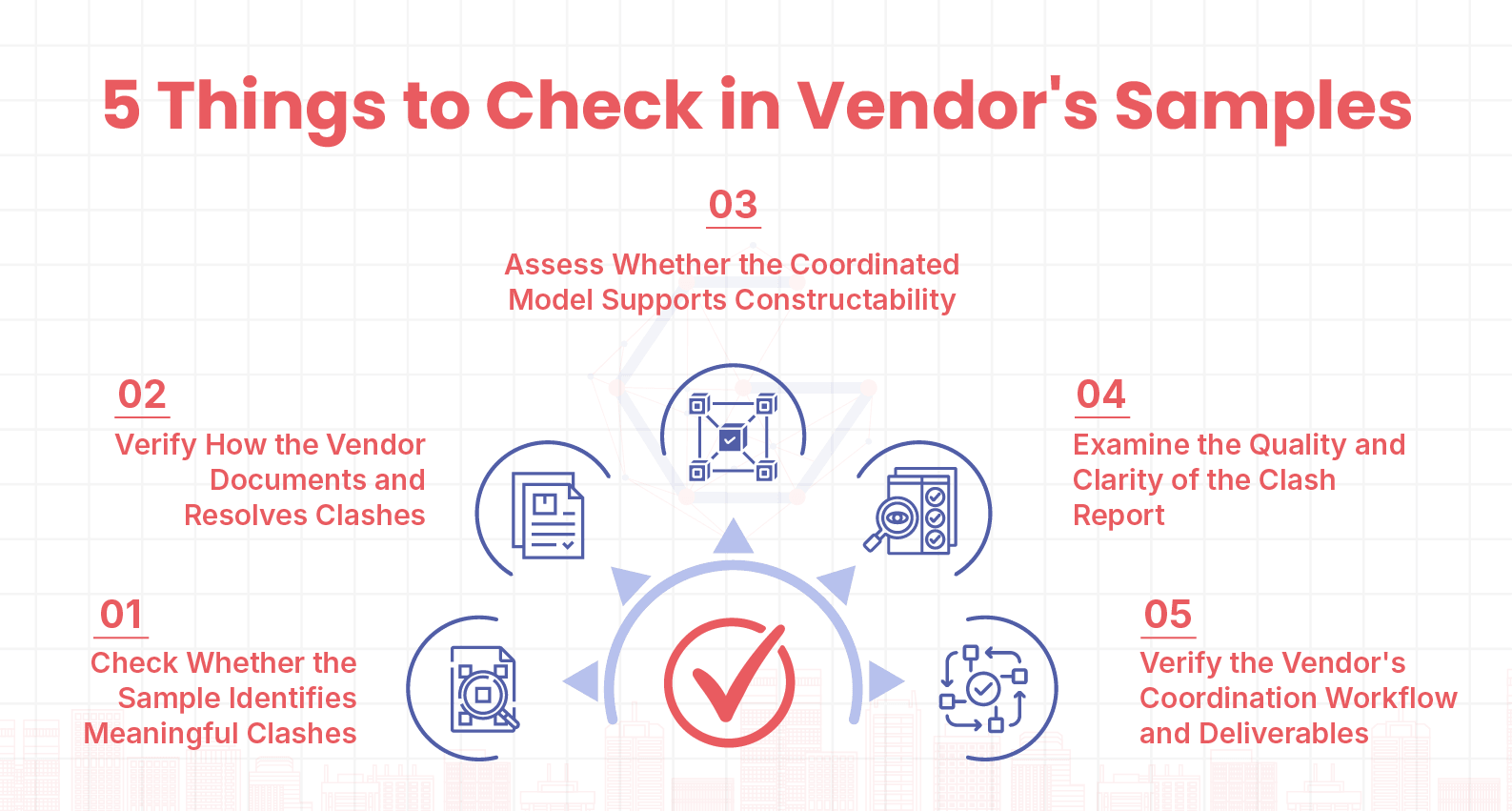
1. Check Whether the Sample Identifies Meaningful Clashes2. Verify How the Vendor Documents and Resolves Clashes
3. Assess Whether the Coordinated Model Supports Constructability
4. Examine the Quality and Clarity of the Clash Report
5. Verify the Vendor's Coordination Workflow and Deliverables
• MEP Vendor Evaluation Checklist
• Choose a MEP Coordination Partner Based on Evidence
• FAQs
At first glance, two vendors’ MEP coordination examples and clash reports may appear equally sound. The real challenge is identifying whether their samples demonstrate effective coordination practices or simply look technically impressive.
When reviewing a vendor portfolio, the real test lies in how they identify and handle clashes, coordinate systems across trades, document issues and resolutions, and prepare accurate coordination drawings. Without clear evaluation criteria, you risk choosing a vendor whose work leads to costly field rework and project delays.
Use these five checks to assess each vendor’s coordination capabilities, compare samples consistently, and make a more informed selection.
1. Check Whether the Sample Identifies Meaningful Clashes
The first thing to examine in an MEP coordination example is whether the sample separates real problems from noise. A coordination check can generate thousands of interferences. A skilled team turns that raw output into a short list of conflicts that need a decision.
If the sample drowns real issues in noise, your coordination meeting time goes to non-issues, and the report loses credibility with the trades. Since it misses real conflicts, they surface on site, where a fix costs far more.
What Meaningful Looks Like In a Sample
- Real conflicts are separated from non-issues: Common noise includes a pipe “clashing” with its own insulation, a duct against its own hanger, or a sleeve intentionally passing through a wall.
- Hard clashes and clearance issues are separate: A hard clash is two elements occupying the same space. A clearance issue is a failure to leave required space, such as access in front of a damper, working space at an electrical panel, or room to service a valve.
- Related clashes are grouped and prioritized: A dozen hanger-to-pipe hits caused by one misplaced support is one decision, not a dozen rows. Related clashes should be grouped and prioritized using project-defined criteria, such as system, level, severity, and required action.
- Tolerances are stated and fit the project: Clearance and tolerance rules vary from project to project, so a sample should say which ones it used.
- Test coverage is visible: The sample lists which system pairs were tested, such as duct against sprinkler piping, plumbing against cable tray, and fire protection against HVAC supports.
Clashes Caught in the Model, Not on Site
See how our MEP team identified and resolved conflicts between ductwork, piping, and other elements on a 340,000 sq. ft. University Building Expansion project.
Read the Case Study2. Verify How the Vendor Documents and Resolves Clashes
Finding a clash is the easy part. The more crucial part of MEP coordination is how teams document clashes clearly and track resolution. This step involves examining the life of a single item, from detection to decision to closure.
If the sample does not record who owns it, what should change, and why, the meeting ends with “we’ll look at it” and the issue returns in the next round, or on site.
What Good Documentation Looks Like
- Each issue can be located in the model: Where relevant, the report should also support on-site identification using grid references, levels, element IDs, and viewpoint images.
- Each entry has an owner and a status: Every issue should identify the responsible trade and have a clear status, such as open, in progress, closed, or deferred.
- Each resolution carries reasoning: The sample should explain which system needs to move and why. For example, gravity-driven drainage must maintain its required slope, while the placement of large mains and ducts should account for available space and the needs of other systems.
- A separate resolution log tracks decisions across rounds: The log should record what was decided, who is responsible for each action, and which issues have been closed. It should be maintained as a separate file alongside the clash report to track decisions and progress across coordination rounds.
Want to Know About MEPF Coordination Support?
Learn how Gsource brings mechanical, electrical, plumbing, and fire protection trades into one workflow, from multi-trade model federation and clash resolution to construction-ready drawings.
Explore MEP Coordination Services3. Assess Whether the Coordinated Model Supports Constructability
A model can appear clash-free and still present installation challenges. For instance, an HVAC duct may clear a structural beam but leave no room to reach a damper. Similarly, equipment may fit within a plant room while leaving inadequate space for servicing.
Resolving a clash on screen by squeezing a pipe into a tight gap may satisfy the software and still leave a crew with no room to install it, and a facilities team with no way to reach a valve. A coordination partner is judged on what happens on site.
What Constructability Looks Like in a Sample
- Access and maintenance space are preserved: The model preserves adequate access and maintenance space for valves, cleanouts, dampers, access doors, and equipment servicing.
- Hangers and supports are considered: The model accounts for hanger zones and shared supports to ensure they do not clash with other trades or interfere with the installation of other systems.
- Sleeves and penetrations are located: Openings through walls and floors are identified and dimensioned, including those in fire-rated assemblies, so they can be coordinated before installation begins.
- Ceiling space adds up: Ducts, pipes, cable trays, and ceiling elements fit within the available ceiling height, with sufficient space for insulation and required clearances.
- Install sequence is plausible: Large or difficult-to-move runs are positioned to allow smaller systems to be installed around them without creating access or installation constraints.
4. Examine the Quality and Clarity of the Clash Report
An effective clash report clearly explains each issue, identifies the conflicting elements, and outlines the next steps for all project stakeholders. Well-defined headings and organized sections make important information easy to find and support faster decision-making.
If your project manager, contractors, and trade crew spend too much time searching for information or clarifying what the report means, it can slow decision-making, even when the underlying coordination work is accurate.
What a Clear Report Looks Like in a Sample
- A summary on the first page: The first page summarizes the coordination scope, review round, rules applied, and the number of issues by status, such as open, closed, or deferred.
- A stated scope: The report identifies the trades covered and the applicable level of development (LOD) or level of detail, clearly stating what is and is not included in the sample.
- Organized by system pair and level: The report groups findings by system pair and building level, allowing readers to quickly locate the areas relevant to them.
- Images that match the text: Each viewpoint image clearly shows the actual conflict described in the report, with consistent naming to help readers identify and reference the issue.
- Plain language: The report uses consistent terminology and clearly explains each issue, its impact, and the action required to address it.
- Trend across rounds: Progress is traceable across review rounds, with the report showing which issues were closed, remain open, were deferred, or were newly identified, along with explanations for significant changes in issue counts.
5. Verify the Vendor’s Coordination Workflow and Deliverables
The final check is to determine whether the vendor’s workflow, including clash detection, communication, and deliverables hand off, fits your project’s requirements. A sample demonstrates the vendor’s work on one project, while the workflow shows whether they have a defined process for delivering consistent results.
Before you rely on a sample, confirm whether they understand your required software, file formats, naming conventions, reporting format, and delivery schedule. Unclear scope is where disputes tend to start.
What a Clear Workflow and Deliverable Set Looks Like
- Defined inputs: The vendor clearly specifies the information and files required to begin the coordination process and confirms that they can work with the types of inputs your team provides.
- Defined rounds: The vendor specifies the number of coordination review or revision rounds and outlines the deliverables expected from each round.
- A complete deliverable set from the same project: The sample includes a consistent set of deliverables from the same project, such as a clash report, resolution log, federated Navisworks file, coordinated drawing sheets, and quantity schedules, along with sleeve and penetration layouts and hanger and support details where included in the scope.
- Everything agrees: Report entries link to the corresponding views in the federated model, drawing sheets reflect the latest coordination review round, and schedules match the elements represented in the model.
MEP Vendor Evaluation Checklist
Use this checklist to assess each vendor consistently. A sample should provide evidence of the capabilities that matter to your project. If a detail is not shown, ask the vendor to clarify or provide supporting documentation rather than assuming the capability is absent.
| Evaluation Criteria | What a Strong Sample Demonstrates |
|---|---|
| Clash Detection | Meaningful conflicts are identified and clearly located. |
| Clash Resolution | Issues are documented with actionable information and traceable follow-up. |
| Constructability | Layouts account for relevant space, access, and installation constraints. |
| Clash Reporting | Findings are organized, understandable, and useful to project stakeholders. |
| Coordination Workflow | Model federation, issue tracking, updates, and deliverables follow a defined process. |
Score each criterion from 1 to 5, where 1 indicates insufficient evidence and 5 indicates strong evidence. Compare the scores alongside your project’s complexity, technical requirements, communication expectations, and budget. The goal is to select a vendor based on demonstrated capabilities and project fit, not presentation quality alone.
Choose an MEP Coordination Partner Based on Evidence
Choosing the right MEP coordination vendor involves more than evaluating technical capabilities through samples. You must also assess whether the samples demonstrate how the team identifies meaningful clashes, communicates issues, considers constructability, documents findings, and manages coordination throughout the workflow.
These checks can help you identify capability gaps, compare vendors more consistently, and reduce the risk of choosing a partner whose deliverables do not meet your project requirements.
Ready to Discuss Your MEP Coordination Requirements?
Share your project scope, coordination requirements, and expected deliverables to discuss the right support for your team.
Request a QuoteFAQs
Look for evidence of meaningful clash detection, clear issue documentation, practical coordination solutions, constructability considerations, and a repeatable coordination workflow. The sample should demonstrate how the vendor supports project teams in identifying and addressing conflicts.
Use the same evaluation checklist for every vendor. Assess clash detection, resolution documentation, constructability, reporting quality, and workflow. Request clarification or additional evidence when a sample does not demonstrate a required capability.
A good clash report identifies the conflicted components and their locations, provides clear descriptions and model viewpoints, and supports prioritization and follow-up. Where applicable, it also records issue status, responsibility, and resolution details.
No. A clash-free model can still contain practical installation or maintenance problems. Coordination reviews should also consider relevant clearances, access requirements, spatial constraints, design intent, and project-specific installation requirements.
Explain your project type, building systems, coordination scope, required software and file formats, expected deliverables, and project complexity. Ask for representative model views and clash reports that demonstrate work comparable to your requirements. You can also request a walkthrough of how identified issues are documented and resolved.
Pavan Mulik is the Vice President of Operations at Gsource Technologies and also serves as Account Manager for Structural and Mechanical Design. With extensive expertise in civil engineering, land surveying, and BIM, he excels at managing complex workflows and driving cross-functional collaboration. His strategic approach ensures smooth project execution at any scale. Outside work, he enjoys exploring landscapes and architectural marvels for inspiration.
Read More