Why Curtain Wall Coordination Breaks Down Before Permit Stage, and How Teams Can Prevent It


Table of Contents
The Problem Usually Starts Before Construction
Why Curtain Wall Coordination Gets Complicated So Quickly
The Most Common Coordination Breakdowns Before the Permit Stage
Why These Problems Usually Surface Right Before Permits
How Teams Reduce Curtain Wall Coordination Risks Earlier
Final Thoughts
FAQs
The Problem Usually Starts Before Construction
Curtain wall coordination problems suddenly appearing during installation are rare. But these issues cropping up much earlier are more common than one might think. This is especially true during the pre-permit coordination stage. Initially, all the trades (architectural, structural, MEP, and facade) seem aligned well.
But as designs evolve and deadlines tighten, small gaps between disciplines start surfacing. A shifted slab edge, an unresolved penetration, or an outdated consultant file may not seem critical initially, but these issues quickly snowball into RFIs, redesigns, and permit-stage delays later on.
By the time coordination problems show up during fabrication or site execution, the root cause has often been sitting unresolved in the drawings for months.
Why Curtain Wall Coordination Gets Complicated So Quickly
Curtain wall coordination gets complicated because facade systems sit right in the middle of multiple disciplines working simultaneously. Architects are refining elevations, structural teams are adjusting slab edges, MEP consultants are routing services, and contractors are planning execution – all at the same time.
The problem is that everyone’s working in parallel, but not always in sync.
A small structural revision or an unresolved penetration in the curtain wall system design may seem manageable initially. But these gaps quickly affect facade layouts, anchoring, clearances, and detailing. In many projects, facade design conflicts aren’t caused by one major mistake – they build up gradually through evolving consultant drawings, incomplete details, and missed communication between teams.
The Most Common Coordination Breakdowns Before the Permit Stage
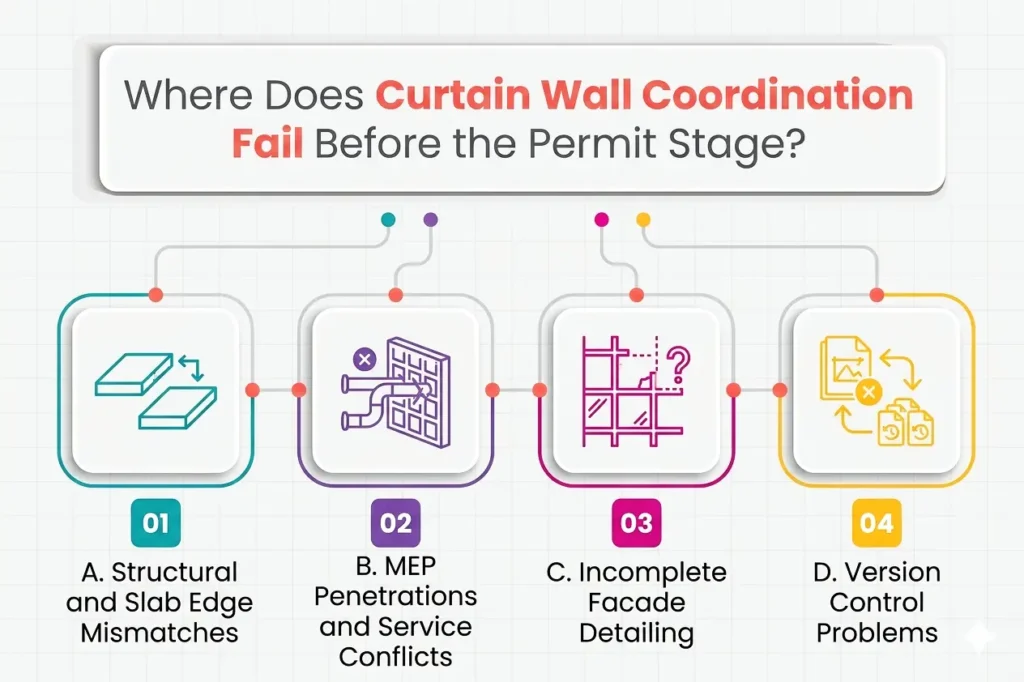
Before permit submission, curtain wall coordination issues build gradually through small gaps between disciplines, evolving drawings, and unresolved detailing decisions.
These then become harder to manage as deadlines approach. Here are some of the most common coordination issues:
-
Structural and Slab Edge Mismatches
One of the most common facade design conflicts arises when structural updates happen later than expected. Slab edges shift, embed locations change, or anchoring assumptions evolve after facade layouts have already progressed. The challenge is that even minor slab variations can affect:
- curtain wall anchoring
- panel alignment
- movement clearances
- installation tolerances
-
MEP Penetrations and Service Conflicts
Facade zones are rarely isolated from MEP systems. Ducts, pipes, louvres, and maintenance access requirements all compete for space near the building envelope. Problems usually appear in the curtain wall system design when:
- penetrations are finalized too late
- louver locations are not coordinated
- maintenance access gets overlooked
- service routes interfere with facade framing zones
-
Incomplete Facade Detailing
At the permit stage, facade drawings may appear complete on paper but still contain unresolved detailing gaps. Common issues include:
- missing movement joints
- unclear waterproofing transitions
- unresolved material interfaces
- incomplete edge conditions
-
Version Control Problems
On fast-moving projects, multiple consultants are constantly updating drawings and models simultaneously. Without strict version tracking, teams can easily end up coordinating against outdated information. This often leads to:
- mismatched backgrounds
- outdated dimensions
- conflicting revisions
- missed mark-ups between disciplines
When these issues aren’t caught early, teams often end up revisiting large portions of the facade package just before permit submission – leading to redesigns, re-coordination, and approval delays.
The tricky part is that many of these conflicts only become visible after consultant submissions begin getting consolidated. By then, coordination timelines are already under pressure.
These details may seem small initially, but they directly affect constructability and long-term envelope performance. In many cases, the drawings look complete – but they are not fully buildable yet.
One outdated background can throw off an entire facade package. And by the time the mismatch is discovered, multiple teams may already be working off the wrong revision.
Small Coordination Gaps Become Expensive Later
Permit-stage facade revisions often begin with unresolved coordination issues much earlier in the project.
Review Your Facade Coordination WorkflowWhy These Problems Usually Surface Right Before Permits
Most facade design conflicts become visible right before permit submission because that’s when all disciplines are trying to finalize their drawings at the same time. Architectural, structural, MEP, and facade teams may have been progressing in parallel for months, but unresolved assumptions often remain hidden until the final coordination push begins.
As permit deadlines get closer, teams have less time to review evolving changes properly. Small gaps that were manageable earlier suddenly become urgent problems affecting layouts, detailing, and approvals. This late-stage coordination pressure in curtain wall system design often leads to:
-
- rushed RFIs
- approval delays
- redesign pressure across disciplines
- compressed review timelines
And once revisions start piling up near the permit stage, recovery becomes much harder for everyone involved.
How Teams Reduce Curtain Wall Coordination Risks Earlier
The most effective way to reduce curtain wall coordination issues is to address them much earlier in the design process – before drawings reach permit stage pressure.
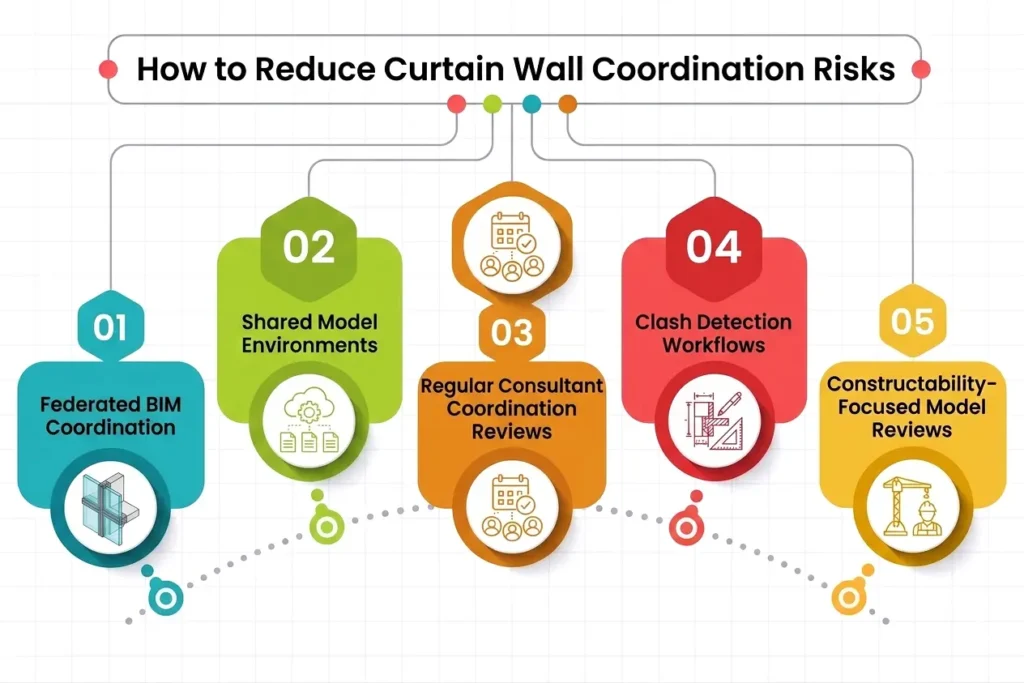
These processes help identify conflicts before they affect fabrication, approvals, or site execution. They also make it easier for architectural, structural, MEP, and facade teams to stay aligned as designs continue evolving.
Many firms also bring in dedicated facade drafting and BIM support teams during pre-permit phases. This helps in maintaining consistency in coordination under tight timelines. This also assists internal teams in managing evolving deliverables without slowing down overall project progress.
Final Thoughts
Most curtain wall coordination problems rarely begin from a single major issue. They usually develop through small gaps in communication, evolving consultant inputs, and unresolved detailing decisions that build up over time.
Projects tend to run far more smoothly when coordination starts early and stays consistent throughout the pre-permit stage. Better alignment between teams ultimately leads to fewer approval delays, cleaner fabrication workflows, and a more efficient construction process overall.
Curtain Wall Coordination Shouldn’t Become a Permit-Stage Firefight
Support facade packages with coordinated BIM workflows, detailing reviews, and multidisciplinary drafting support before revisions begin piling up.
Discuss Your Facade RequirementsFAQs
Why does curtain wall coordination often break down before permit stage?
Curtain wall coordination involves multiple disciplines working simultaneously. As drawings evolve, small gaps between architectural, structural, MEP, and facade inputs can quickly create conflicts if they are not reviewed consistently.
What are the most common facade coordination issues on commercial projects?
Common issues include slab edge mismatches, unresolved penetrations, incomplete facade detailing, version control problems, and clashes between facade systems and MEP services.
How does BIM improve curtain wall coordination?
BIM helps teams work within a shared model environment, making it easier to identify clashes, review constructability, track revisions, and maintain coordination across disciplines before construction begins.
Why do facade coordination issues become more visible near permit submission?
Most disciplines finalize drawings around the same time before the permit stage. This is usually when unresolved assumptions, conflicting revisions, and coordination gaps start surfacing under tight deadlines.
How can teams reduce facade redesigns and permit-stage revisions?
Early coordination reviews, federated BIM models, structured clash detection, and regular consultant checkpoints can help identify issues before they affect approvals or fabrication workflows.
When does it make sense to involve external facade drafting or BIM support teams?
Many firms bring in dedicated facade drafting or BIM support during fast-track, large-scale, or coordination-heavy projects where internal teams need additional production and coordination bandwidth.
Pavan Mulik is the Vice President of Operations at Gsource Technologies and also serves as Account Manager for Structural and Mechanical Design. With extensive expertise in civil engineering, land surveying, and BIM, he excels at managing complex workflows and driving cross-functional collaboration. His strategic approach ensures smooth project execution at any scale. Outside work, he enjoys exploring landscapes and architectural marvels for inspiration.
Read More