What Must Be Included in Fabrication Drawings for Signage Permit Approval


Table of Contents
Introduction
What are Fabrication Drawings?
Understanding what permit reviewers are looking for
Get the Foundation Right with Fabrication Drawings for Signage Permit Approval
Why do Permit Authorities reject signage applications?
What Experienced Fabricators Do Differently
Conclusion
FAQs
Introduction
Imagine a signage project that looks perfect on the outside, the design is approved, brand elements are in place, and installation is scheduled. But one missing detail in fabrication drawings can bring the entire process to halt, be it small structural details or safety specifications.
Fabrication drawings are more than just production documents, they are technical proof that your signage is safe, code-compliant, and ready for installation. From mounting detail to electrical layouts, every element must communicate what will be built.
In this blog, understand what permit authorities need in drawings to avoid delays, costly revisions, and rejected applications.
What are Fabrication Drawings?
Fabrication drawings or shop drawings are technical blueprints that translate creative sign concepts into buildable instructions for the manufacturing team. They act as a bridge between aesthetic design and physical reality by detailing the exact measurements.
These drawings matter in signage: while the design drawings show what signs look like, the fabrication drawings show how they will be made. Signage fabrication detailed drawings ensure structural integrity, code compliance, and smooth execution.
Not sure if your current signage fabrication drawings meet permit requirements?
Our experts will review your drawings before they cause approval delays
Contact us now!Understanding what permit reviewers are looking for?
Permit reviewers evaluate signage applications for compliance and safety purposes. They check whether the fabrication drawings provide technical information to confirm signs are safely installed, manufactured, and maintained.
-
Clear Proof of Code Compliance
Permit authorities want to see proposed signage follow all the local building codes, sign ordinances, and zoning regulations. Fabrication drawings clearly include sign dimension and placement, distance from property boundaries, height, and clearance requirements.
-
Accurate Sign Dimensions and Layout Details
Reviewers need precise measurements to compare the proposed sign with permitted limits. Detailed drawings must include individual letter dimensions, overall sign size, panel size and thickness, and mounting locations.
-
Structural Safety and Installation Method
The primary concern for permit reviewers is whether the sign can withstand real-world conditions. They look for support calculations, structural framing details, anchor bolt specifications, and attachment methods to walls, roofs, or structures.
-
Complete Elevation and Section Views
The permit authorities rely on multiple drawing views to understand the final installation. They typically expect side sections showing depth and projection, front elevation showing appearance and placement, and a detailed view of connection and assemblies.
-
Material Durability and Weather Resistance
The reviewers ensure signs remain safe and functional over time. Drawings should specify protective coating, fabrication materials, finish specifications, and weatherproofing methods to understand weather resistance.
Get the Foundation Right: What Must Be Included in Fabrication Drawings for Signage Permit Approval
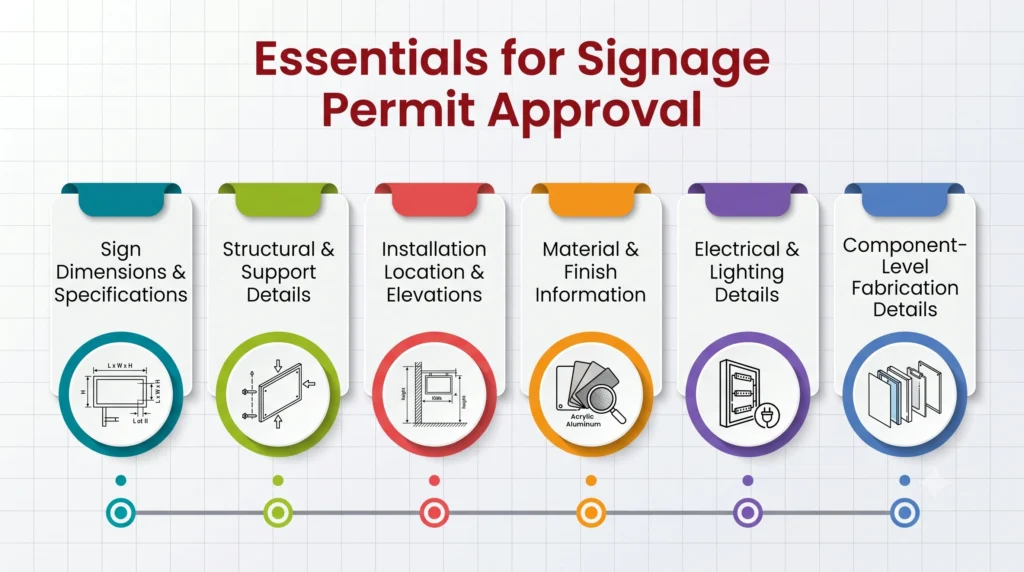
A successful signage permit approval starts with fabrication drawings that provide technical clarity and compliance. These drawings are a foundation between design intent, manufacturing, installation, and compliance.
Here are the main components that must be included in fabrication drawings for fast signage permit approval.
-
Detailed Sign Dimensions and Specifications
Permit reviewers need precise measurements to confirm signs meet the local regulations. Fabrication drawings must include overall sign dimensions; panel thickness and framing sizes; letter height, depth, and spacing; and scale details for accurate review.
-
Complete Structural and Support Details
The signage must be structurally safe before it can be approved. Signage Fabrication Drawings define how the sign will be supported, which includes anchor bolt specifications, structural framework details, mounting brackets, and connection points.
-
Accurate Installation Location and Elevations
The fabrication drawing provider must include the accurate installation location as to where the sign will be installed. Fabrication drawings must show exact sign placement, building elevation views, distance from windows, edges, and entrance, and height above ground level.
-
Material and Finish Information
Permit reviewers must check whether proposed materials are suitable for durability and safety. This includes surface finishes, material types and thickness, paint or coating specifications, weather-resistant details, and corrosion protection methods.
-
Electrical and Lighting Detail for Illuminated Signs
For internally or externally illuminated signage, drawings must provide clear visibility into electrical safety requirements like LED modules, lighting components, power supply details, wiring routes, and electrical load information.
-
Fabrication Details for every sign component
A permit drawing must go beyond appearance and explain how the sign will be built. Important details include welded or mechanical connection, assembly methods, hardware specifications, and manufacturing notes.
Why do Permit Authorities reject signage applications?
Let’s be honest, many applications get rejected because fabrication drawings fail to provide technical details needed for approval, and then the sign concept itself.
Here are the reasons why permit authorities to reject signage applications.
-
Missing Structural Details and Load Information
Permit reviewers have to ensure that the sign safely withstands environmental conditions like weight loads, wind pressure, and mounting forces. The application may get rejected when fabrication drawings do not include material specifications, structural framing details, or connection details with the building structure.
-
Incomplete Dimensions and Sign Specification
Authorities need accurate measurements to verify compliance with local sign codes. An application may be rejected when drawings lack letter height and depth, overall sign dimensions, projection distance from the building, or clearance from roads and sidewalks.
-
Non-Compliant Sign Placement Details
The sign may be rejected if the location does not meet the zoning regulations, as the fabrication drawing clearly shows the building elevation view, installation location, and any setback or property line distance.
-
Uncertain Electrical and Lighting Information
For illuminated signage, permit reviewers must have complete electrical details to confirm safety compliance. Missing information like power supply details, LED/neon specification, and electrical load calculation can delay the approval
-
Fail to Match Local Sign Codes and Regulations
Each location has specific requirements related to sign size, illumination, height, and placement. Applications are rejected when fabrication drawings do not demonstrate compliance with building codes, zoning restrictions, and safety standards.
What Experienced Fabricators Do Differently
Experienced signage fabricators understand that permit approval depends on more than creating attractive signage. They focus on detailed fabrication drawings that balance design intent, installation practicality, and structural safety.
-
They design with permit approval in mind
Skilled fabricators ensure approval requirements from the beginning rather than having permits as a final step. They ensure drawings include information for reviewers, reduce unnecessary revisions, and approval delays.
-
They provide complete technical documentation
Professional fabricators must create drawings that communicate every manufacturing and installation detail, which include assembly details, material specifications, exact dimensions, mounting methods, and structural connections.
-
They Think Beyond the Sign Face
The less experienced teams focus only on the visible design, but experienced fabricators consider the whole sign system from internal framing to building attachment. They analyze support requirements, wind loads and structural stability, installation challenges, and long-term durability.
-
Fabricators coordinate design and engineering needs
Fabrication drawings must work for everyone involved. Experienced fabricators ensure smooth coordination between engineers, designers, permit reviewers, and installation teams. This prevents conflict between drawings and actual site conditions.
-
They create installation-friendly drawings
The good fabrication drawing not only shows what the sign looks like but also explains how it will be installed. The experts ensure installation-friendly drawings by including connection details, assembly sequence, hardware specifications, and access requirements.
Need fabrication drawings that are permit-ready?
Connect with our experts to create accurate signage documentation
Talk to our expertsConclusion
The successful signage installation begins with accurate and permit-ready fabrication drawings. These drawings act as a bridge between fabricators, designers, engineers, and permit authorities as it ensures every detail meets accuracy, safety, and local code requirements.
Partnering with experienced fabrication drawing providers like Gsource helps to ensure your signage documentation is approved in one go, making the installation smoother and faster.
FAQ’s
Why does signage permit application get rejected even when design looks right?
A good signage design application may get rejected due to fabrication drawings lack critical technical details like mounting methods, structural calculations, electrical layouts, or code compliance.
How can accurate fabrication drawings reduce signage installation delays?
Incomplete or unclear drawings lead to fabrication errors, permit revision, and installation setbacks. Detailed fabrication drawings create a clear roadmap for fabricators, engineers, and installers, which reduces communication gaps and help project move from approval to installation faster.
What details do permit authorities look for in signage fabrication drawings?
Permit authorities review fabrication drawings for sign placement, accurate dimensions, load requirements, material information, illumination detail, and installation methods as signage is safe and meets local building and electrical codes.
Should businesses outsource signage fabrication drawings for complex permit projects?
For large-scale, illuminated, or structurally complex signs, outsourcing fabrication drawings can help businesses access specialized drafting expertise without increasing internal workload.
What makes a signage fabrication drawing permit ready?
A permit-ready fabrication drawing includes technical information from precise measurements to connection details. Working with a skilled drafting partner ensures drawings are detailed and permit-ready.
Pavan Mulik is the Vice President of Operations at Gsource Technologies and also serves as Account Manager for Structural and Mechanical Design. With extensive expertise in civil engineering, land surveying, and BIM, he excels at managing complex workflows and driving cross-functional collaboration. His strategic approach ensures smooth project execution at any scale. Outside work, he enjoys exploring landscapes and architectural marvels for inspiration.
Read More