Hidden Costs of In-House MEP Drafting That Contractors Often Overlook

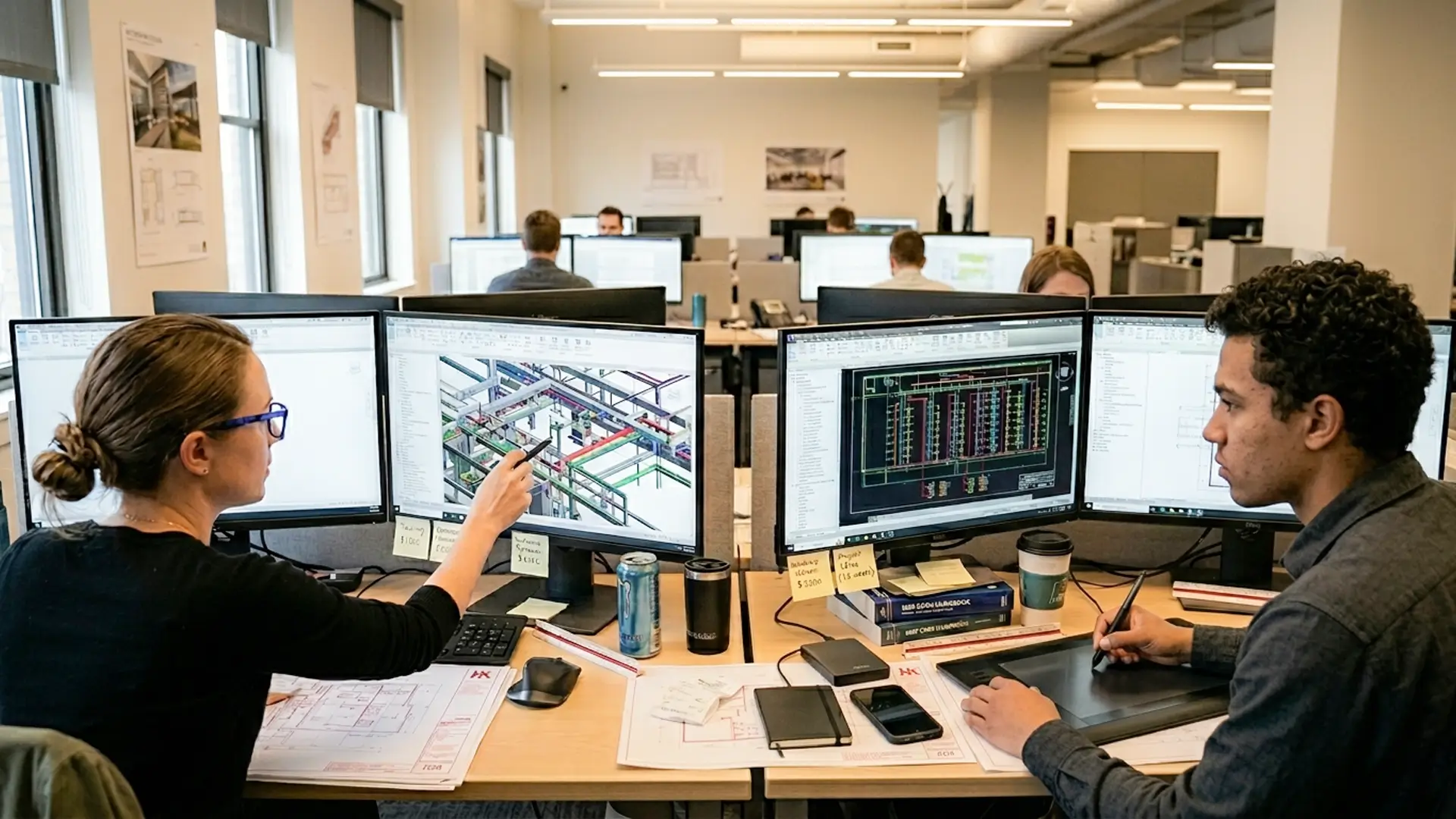
Table of Contents
Introduction
What In-House MEP Drafting Typically Includes
The Bigger Picture: Total Cost vs Visible Cost
How Outsourcing MEP Drafting Addresses These Challenges
Conclusion: Rethinking the Cost of In-House
FAQs
Introduction: The True Cost of “In-House”
For many contractors, keeping MEP drafting in-house feels like the most cost-effective and controlled option. You have your team, your tools, and your processes- everything under one roof.
But if you look a little closer, the real cost extends beyond just salaries and software. From hiring and training to downtime during slow periods, there are several hidden expenses that quietly add up. You might not notice them on a day-to-day basis, but they can significantly impact your project budgets and timelines. Before assuming that in-house is the cheaper route as compared to outsourcing MEP drafting, it’s worth taking a closer look at what it truly costs.
What In-House MEP Drafting Typically Includes
When contractors think about in-house drafting, they often focus on the core team. But in reality, it involves a much broader setup:
-
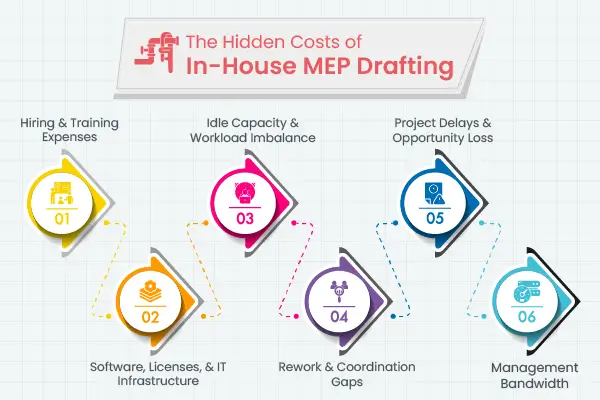
Hidden Cost 1: Hiring and Training Expenses
This is an important step where building an in-house MEP team doesn’t just mean paying salaries. It starts with the time and cost of finding the right talent- screening candidates, conducting interviews, and onboarding new hires.
Once they’re in, there’s a learning curve. Teams need to be trained on your standards, workflows, and project requirements. And just when they’re fully up to speed, attrition can set you back again, forcing you to repeat the cycle.
These ongoing hiring and training efforts don’t always show up as direct project costs, but they significantly impact timelines, productivity, and overall efficiency.
-
Hidden Cost #2: Software, Licenses, and IT Infrastructure
Beyond salaries, in-house MEP drafting comes with ongoing technology costs. Licensed software like AutoCAD and Revit requires regular subscriptions and upgrades to stay current. Add to that high-performance systems capable of handling large BIM models, along with servers, cloud storage, and backup solutions. IT support is also essential to manage installations, troubleshoot issues, and maintain data security.
These costs don’t come as a one-time investment; they’re recurring and often increase as projects scale. Over time, software and infrastructure expenses can take up a significant portion of your overall drafting budget, which can be avoided by outsourcing MEP drafting.
-
Hidden Cost #3: Idle Capacity and Workload Imbalance
In-house teams are fixed, but project workloads aren’t. During slower periods, you’re still paying full-time salaries for underutilized resources. And when work peaks, the same team can quickly become overwhelmed, leading to delays or rushed outputs. This imbalance makes it difficult to maintain efficiency across projects. Scaling up requires hiring, while scaling down isn’t always practical.
As a result, you either pay for idle capacity or risk overloading your team. Over time, this constant mismatch between workload and resources can quietly drive up costs and impact overall productivity.
-
Hidden Cost #4: Rework and Coordination Gaps
Even with a skilled in-house team, coordination across disciplines isn’t always seamless. When architectural, structural, and MEP drawings aren’t fully aligned, clashes can slip through and only get caught later, often on-site. That’s when rework begins, costing time, materials, and effort. These gaps usually come from siloed workflows, limited cross-checking, or time constraints during busy phases.
What seems like a small oversight can quickly become a larger issue that impacts timelines and budgets. Compared to outsourcing MEP drafting, repeated rework and coordination challenges can significantly increase the true cost of maintaining an in-house team.
-
Hidden Cost #5: Project Delays and Opportunity Loss
When drafting capacity is limited, timelines can start to slip, especially during peak workloads. Delays in drawings often push back approvals, coordination, and eventually construction.
This not only affects current projects but can also impact your ability to take on new work. Missed deadlines may lead to penalties, strained client relationships, or lost bids. Even small delays can have a ripple effect across the project lifecycle.
Over time, these missed opportunities and slowed turnaround can cost far more than the visible expenses of maintaining an in-house team.
-
Hidden Cost #6: Management Bandwidth
Managing an in-house MEP drafting team requires more time than it initially appears. Project managers and senior engineers often spend significant hours reviewing drawings, coordinating across disciplines, and resolving day-to-day issues. This takes focus away from higher-value tasks like design decisions, client communication, and project strategy.
As workloads increase, so does the pressure on management to keep everything aligned. Over time, this added responsibility can slow down decision-making and impact overall project efficiency, making management bandwidth a hidden but critical cost.
Looking to avoid hidden in-house costs?
Outsource your MEP drafting to a trusted partner.
Request a QuoteThe Bigger Picture: Total Cost vs. Visible Cost
When evaluating in-house MEP drafting, most contractors focus on visible costs- primarily salaries and software. But the total cost goes much deeper, including indirect and often overlooked expenses that impact efficiency and profitability.
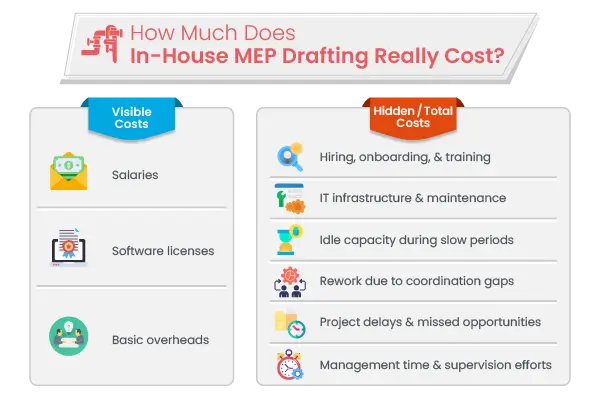
While visible costs are easy to track, hidden costs quietly accumulate across projects. Over time, they can significantly increase your overall spend and reduce operational efficiency.
How Outsourcing MEP Drafting Addresses These Challenges
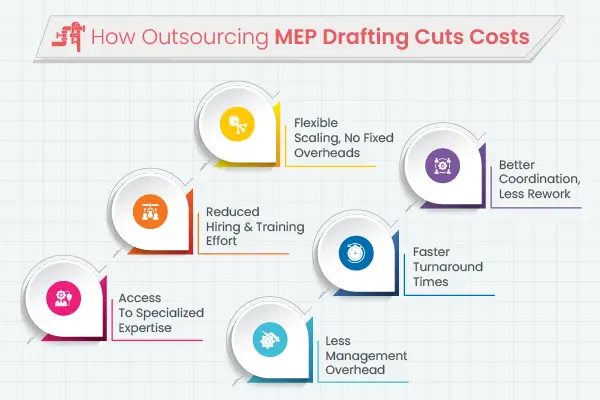
Outsourcing MEP drafting has the potential to significantly reduce your overall expenses and make operations easier as well.
-
Flexible scaling without fixed overheads
Outsourcing allows teams to scale resources up or down based on project demand, avoiding the cost of idle capacity during slow periods.
-
Reduced hiring and training burden
With experienced teams already in place, there’s no need to invest time and money into recruitment, onboarding, or upskilling.
-
Access to specialized expertise
External partners bring domain-specific knowledge and proven workflows, improving accuracy and reducing the likelihood of errors.
-
Improved coordination and reduced rework
Structured processes and cross-disciplinary experience help ensure better alignment between drawings, minimizing costly rework.
-
Faster turnaround times
Dedicated teams and streamlined workflows enable quicker delivery, helping you meet tight deadlines and take on more projects.
-
Reduced management effort
With execution handled externally, internal teams can focus on core engineering tasks and strategic decisions.
Conclusion: Rethinking the “Cost” of In-House
At first glance, in-house MEP drafting appears to offer more control and cost efficiency. But when you factor in hiring, training, idle capacity, rework, and management time, the true cost becomes much higher than it seems. These hidden expenses don’t just impact budgets; they affect timelines, productivity, and your ability to scale. Looking beyond the visible costs allows contractors to make more informed, strategic decisions.
This is where outsourcing starts to shift from a cost-saving tactic to a performance advantage. With the right partner, teams gain flexibility, faster turnaround, and access to experienced resources without the operational burden. Leading companies like Gsource Technologies support this transition by aligning with existing workflows and delivering consistent, high-quality outputs, helping teams focus on what truly drives project success.
Skip the hidden costs of in-house teams.
Scale smarter with outsourced MEP support.
FAQs
Is outsourcing MEP drafting more cost-effective than in-house teams?
Yes, outsourcing often reduces overall costs by eliminating expenses related to hiring, training, software, and idle capacity.
How does Gsource ensure quality in outsourced MEP drafting?
Gsource follows structured workflows, quality checks, and industry standards to deliver accurate, coordinated, and construction-ready drawings.
Can outsourcing MEP drafting help meet tight project deadlines?
Absolutely. With dedicated teams and scalable resources, outsourcing partners can accelerate delivery and help meet strict timelines.
What types of projects can Gsource support?
Gsource supports a wide range of projects, including commercial, residential, and infrastructure developments, with end-to-end MEP drafting services.
Will outsourcing affect communication and coordination?
Not when done right. Established partners use clear communication channels and collaborative tools to ensure smooth coordination throughout the project.
How does Gsource integrate with existing workflows?
Gsource aligns with client standards, tools, and processes, ensuring seamless integration without disrupting ongoing workflows.
Mukul Bhagia is the BIM Manager at Gsource Technologies, specializing in MEPF systems and digital coordination. With a strong foundation in mechanical, electrical, plumbing, and fire protection design, Mukul brings precision and innovation to every project. He is adept at streamlining complex BIM workflows, ensuring seamless collaboration across multi-trade teams, and reducing project risks through proactive clash detection. Beyond his professional role, he often finds inspiration in learning about how cities evolve through engineering and design.
Read More