How the Shop Drawing Approval Process Can Speed Up Project Delivery by 30%


Table of Contents
Introduction
What are Shop Drawings in Construction projects?
Common Bottlenecks That Delay Project Delivery
How an Efficient Shop Drawing Approval Process Speeds Up Delivery by 30%
Best Practices for Faster Shop Drawing Approvals
Why Outsourcing shop drawing services accelerates project delivery
Conclusion
FAQs
Introduction
A commercial construction project was running late before fabrication had even started. The issue was not a shortage of internal team or material delays, but a slow shop drawing approval process. Multiple revisions and delayed stakeholder response created a bottleneck, but after restructuring the
shop drawings approval process with better coordination, the project team reduced the approval cycle by 30% and recovered valuable project time.
In this blog, learn how to streamline approvals, accelerate timelines, and improve collaboration to speed up project delivery.
What are Shop Drawings in Construction projects?
Shop drawings are detailed drawings that provide information on how components in construction projects should be maintained. The drawings include precise information about materials, dimensions, and component coordination that fabricators, contractors, and the site team need for accurate execution.
Unlike design drawings, shop drawings focus on how building elements will be manufactured, assembled, and installed on-site. From HVAC systems to millwork, shop drawings improve coordination, reduce errors, and keep construction projects moving efficiently.
Common Bottlenecks That Delay Project Delivery
Even the most well-planned construction faces costly delays, so checkout common bottlenecks which delay project delivery.
-
Slow Approval cycle from multiple stakeholders
Shop drawings go through multiple engineers, architects, consultants, and contractors for review. Unstructured approval or delayed response can slow down the decision-making process and extend the project timeline.
-
Excessive Rework and Revision
Poor coordination between disciplines results in rework and revisions to shop drawings. Multiple revisions increase turnaround time and create unnecessary workloads on project teams.
-
Lack of BIM Coordination and Clash Detection
Without proper BIM coordination, MEP clashes and architectural system problems are discovered during installation instead of the design phase. This led to costly site modifications and schedule delays.
-
Delayed RFIs and Design Clarification
When a request for information (RFIs) is not properly addressed, then approval cycles slow down. Project teams are forced to wait for design clarifications before moving to the fabrication or installation stage.
-
Tight Construction Schedules and Resource Constraints
Many construction firms manage multiple projects simultaneously with limited in-house resources. This resource constraint creates bottlenecks in drafting, reviewing, and approving shop drawings on time.
How an Efficient Shop Drawing Approval Process Speeds Up Delivery by 30%
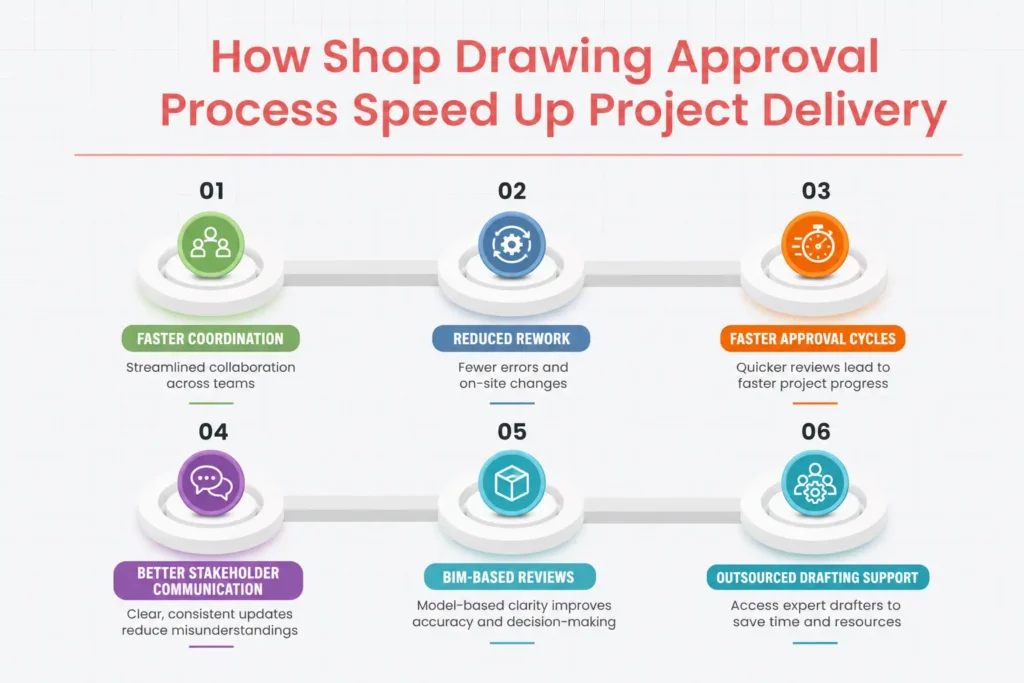
Having a streamline shop drawing approval process helps team to speed up delivery, improve coordination, eliminate rework and move projects from design to construction.
-
Faster coordination reduces construction delays
The efficient approval workflow process improves coordination between engineers, architects, contractors, and fabricators from the start of the project. Real-time updates and faster communication help teams resolve issues early, which prevents delays during installation.
-
Reduced Rework saves valuable project time
Accurate and well-coordinated shop drawings reduce design conflicts and on-site errors. With less revision and rework, the construction team moves faster and maintains the project schedule more efficiently.
-
Faster approval cycle improves workflow efficiency
When shop drawings are reviewed and approved on time, the fabrication and procurement team starts work without waiting for clarifications. This streamlined process keeps every project phase moving smoothly and reduces downtime.
-
Better Communication between stakeholders
The structured approval process creates clear communication between consultants, project managers, subcontractors, and drafting teams. Faster feedback and decision-making help to eliminate approval bottlenecks and improve project delivery speed.
-
BIM-Based Review improves clash detection
Using BIM and coordinated shop drawings helps to identify clashes before construction begins. Detecting conflicts early avoids the expensive site changes, installation delays, and disruption to project timelines.
-
Outsourced drafting support speeds up turnaround time
Many construction teams that outsource shop drawing services have access to experienced drafting teams and scalable resources. This helps to manage high project volumes efficiently while reducing turnaround time.
Best Practices for Faster Shop Drawing Approvals
Following are best practices to ensure faster shop drawing approval across every project stakeholder.
-
Standardized shop drawing submission formats
Using consistent, templated annotation practices and layer standards makes drawings easy to review and approve. Standardized submission reduces confusion, minimizes correction requests, and speeds up the approval cycle.
-
Set clear approval timelines and responsibilities
Defining review deadlines for consultants, architects, and contractors to prevent unnecessary waiting periods. A structured approval workflow ensures accountability and keeps projects moving without bottlenecks.
-
Implement BIM-based coordination early
Integrating BIM coordination during the drafting stage helps to identify clashes and design conflicts before approval begins. Early coordination reduces rework, improves accuracy, and keeps the construction schedule on track.
-
Improve communication between stakeholders
Regular coordination meetings and real-time coordination between design teams, contractors, and fabricators resolve issues faster. Better communication reduces approval delays caused by misinterpretation or missing information.
-
Conduct an internal quality check before submission
Reviewing shop drawings internally before sending them for approval helps detect errors early. High-quality submissions reduce the rejection rate and avoid multiple revision cycles.
Why Outsourcing shop drawing services accelerates project delivery
Outsourcing shop drawing services help the construction team to access experienced drafting support, smooth project coordination, and faster turnaround time.
Want to know more, here are points on why outsourcing accelerates project delivery.
-
Access to Experienced Drafting and BIM professionals
Outsourcing gives construction firms access to skilled shop drawing experts with experience across structural, MEP, architectural, and fabrication projects. An experienced team provides accurate drawings faster, reduces approval delays, and reduces rework.
-
Reduced Rework through better accuracy
Professional outsourcing structural partners follow quality checks, standardized workflows, and BIM coordination practices to reduce drawing errors. Accurate shop drawings reduce revision cycles and help the project move faster from approval to execution.
-
Faster Turnaround time for high-volume projects
Dedicated offshore drafting team helps manage multiple projects without overloading in-house resources. This improves drawing submission speed and keeps the approval workflow process moving efficiently.
-
Scalable support based on project demand
Regular coordination meetings and real-time coordination between design teams, contractors, and fabricators resolve issues faster. Better communication reduces approval delays caused by misinterpretation or missing information.
-
Conduct an internal quality check before submission
Construction workloads fluctuate based on project size and deadlines. Outsourcing allows firms to quickly scale drafting resources up or down without the cost and delays of hiring internally.
-
Deliver the project up to 30% Faster
By reducing drafting bottlenecks, accelerating approvals, and improving coordination, outsourced shop drawing services help firms to shorten the project timeline while improving quality and client satisfaction.
-
24/7 workflow for global projects
Many outsourcing partners operate across different time zones, allowing work to continue even after standard office hours. This creates a faster turnaround and helps to shorten overall project delivery timelines.
Conclusion
With a fast-moving construction industry, project delays are no longer just scheduling issues but impact the profitability, client relationships, and future business opportunities. Having an efficient shop drawing approval process helps to reduce costly rework, eliminate coordination gaps, and keep fabrication and construction moving without interruption.
Streamline the shop drawing approval process to help construction projects achieve 30% faster delivery with lower rework cost.
FAQs
How does the shop drawing approval process impact the project timelines?
The shop drawing approval process affects the fabrication, purchase, and on-site installation schedules. Delays in approval can slow down the construction, while faster approval offers smooth project execution and reduces downtime.
What is the main reason for the delay in shop drawing approvals?
The main reasons include slow stakeholder response, inaccurate shop drawings, lack of BIM coordination, and poor communication between contractors, architects, and fabricators.
Can an efficient shop drawing approval process improve the project delivery by 30%?
Yes, streamlined approval workflow reduces rework, improves coordination, and accelerates fabrication timelines. Many construction firms achieve fast project delivery by reducing bottlenecks and improving collaboration.
Why is reducing rework important for faster project delivery?
Reworks consume valuable project time, delay fabrication activities, and increase labor costs. Accurate and coordinated shop drawings help to eliminate costly errors and keep construction on track.
How does outsourcing shop drawing services help to accelerate the approval?
Outsourcing provides experienced drafting and BIM professionals to deliver accurate shop drawings with a faster turnaround time. Dedicated resources manage high-volume projects without overloading the in-house teams.
Pavan Mulik is the Vice President of Operations at Gsource Technologies and also serves as Account Manager for Structural and Mechanical Design. With extensive expertise in civil engineering, land surveying, and BIM, he excels at managing complex workflows and driving cross-functional collaboration. His strategic approach ensures smooth project execution at any scale. Outside work, he enjoys exploring landscapes and architectural marvels for inspiration.
Read More