How Plumbing Drafting Outsourcing Helps Contractors Reduce Costs by 20–30%

Table of Contents
Introduction
Where Plumbing Projects Lose Money
In-House vs Outsourced Plumbing Drafting
How Outsourcing Plumbing Drafting Services Reduces Costs
Real-World Scenario
When Outsourcing Makes Financial Sense
What to Look for in a Plumbing Drafting Partner
Conclusion
FAQs
Introduction
Are plumbing drafting costs quietly eating into your project margins? Budget overruns rarely come from a single issue- they build up through small inefficiencies. Rework caused by coordination gaps, delays in updating drawings, and the cost of maintaining in-house teams during fluctuating workloads all add up.
During peak phases, teams struggle to keep up; during slow periods, resources sit underutilized. The result is inconsistent output, missed timelines, and rising project costs. This raises an important question: Is plumbing drafting outsourcing actually more cost-effective at scale?
Where Plumbing Projects Lose Money
Cost overruns in large projects seem unavoidable, but they don’t have to be. Most costs of outsourcing plumbing drafting don’t come from major failures- they build up through everyday inefficiencies:
-
Rework from coordination gaps
Misalignment between plumbing, mechanical, and structural systems leads to repeated revisions and site-level fixes.
-
Delays due to limited drafting capacity
In-house teams struggle to keep pace during peak phases, slowing down approvals and execution.
-
Inefficient revision management
Frequent design changes without structured workflows result in version conflicts and wasted effort.
-
High overhead of full-time teams
Fixed staffing costs remain constant, even when project workload fluctuates.
These hidden inefficiencies quietly impact both project timelines and overall budgets.
In-House vs Outsourced Plumbing Drafting
Multiple hidden costs can surface with in-house teams, while outsourcing might bring certain coordination challenges. When evaluating cost and efficiency between in-house and outsourced plumbing drafting, the difference comes down to flexibility and scalability:
| Factor | In-House | Outsourced |
|---|---|---|
| Cost | Fixed overhead (salaries, tools) | Variable, project-based |
| Scalability | Limited by team size | On-demand, scales with project needs |
| Turnaround | Depends on internal bandwidth | Faster with dedicated teams |
For large or multi-phase projects, outsourcing plumbing drafting offers greater cost control and delivery flexibility without long-term commitments.
How Outsourcing Plumbing Drafting Services Reduces Costs
Outsourcing Plumbing drafting services directly impacts project costs through multiple efficiency levers:
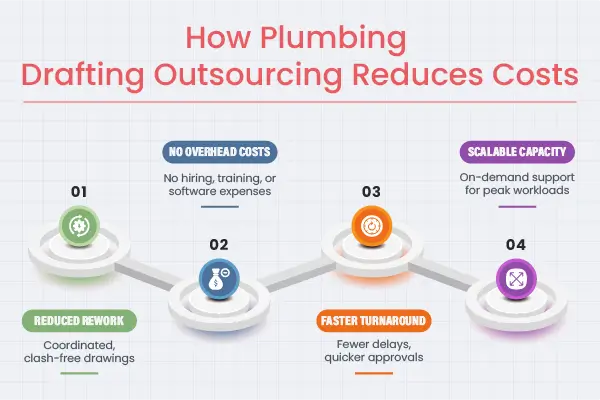
- Reduced Rework Through Coordinated Drawings
Coordinated plumbing models aligned with architectural and MEP systems help minimize clashes and design conflicts. This reduces the need for repeated revisions and avoids costly on-site corrections, which often escalate budgets.
- No Hiring or Training Overhead
Building and maintaining an in-house drafting team involves recruitment, onboarding, software costs, and continuous training. Outsourcing eliminates these fixed expenses, allowing firms to convert them into variable, project-based costs.
- Faster Turnaround, Lower Delay Costs
Dedicated external teams can accelerate drafting timelines, ensuring drawings are delivered on schedule. Faster turnaround directly impacts project timelines by reducing delays in approvals, procurement, and construction.
- Scalable Capacity for Peak Workloads
Project demands fluctuate, especially in multi-phase developments. Outsourcing provides the flexibility to scale resources up or down as needed, avoiding both underutilization during slow periods and bottlenecks during peak phases.
Together, these factors help contractors maintain tighter control over budgets while improving overall project efficiency and delivery speed.
Plan Your Plumbing Drafting Capacity Before Costs Escalate
Scale your drafting output without increasing overhead or risking delays.
Request a Sample Plumbing Drawing NowReal-World Scenario: Controlling Costs on a Multi-Floor Institutional Project
A contractor working on a large 8-acre institutional library project in Texas began facing delays due to repeated plumbing revisions and coordination issues across disciplines.
- The Problem
Initial plumbing inputs contained inaccuracies, and tight ceiling spaces made it difficult to maintain proper drainage slopes. Frequent clashes between plumbing pipes and mechanical ductwork led to continuous rework. With evolving architectural and structural inputs, the internal team struggled to keep drawings aligned, impacting timelines and driving up project costs.
- The Outsourcing Intervention
A structured outsourcing approach was introduced, starting with the validation of all plumbing inputs against standards and drawings. The team optimized pipe routing using Revit’s slope tools and 3D coordination while maintaining required clearances. Regular clash detection and coordination with mechanical systems ensured smoother integration, while continuous updates were managed without slowing progress.
- The Outcome
The project achieved a 28% reduction in plumbing coordination clashes, significantly lowering rework and associated costs. Faster coordination cycles and fewer revisions helped keep the project on schedule.
In real terms, these efficiencies translated into an estimated 20–30% reduction in overall drafting-related costs, driven by reduced rework, faster turnaround, and better resource utilization, clearly demonstrating how outsourcing can directly improve project budgets at scale.
When Outsourcing Makes Financial Sense
Outsourcing plumbing drafting is highly beneficial when project complexity and workload begin to outpace internal capacity.
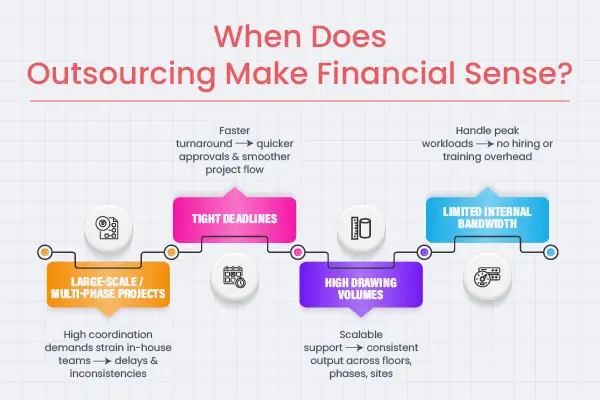
In these scenarios, outsourcing shifts drafting from a fixed cost burden to a flexible, performance-driven model, helping contractors stay on schedule and within budget.
What to Look for in a Plumbing Drafting Partner
An ideal plumbing drafting partner should tick the following points off your checklist.
- Experience with large-scale projects
Ability to handle multi-phase developments and complex coordination across disciplines
- Strong BIM and coordination expertise
Ensures clash-free, constructible designs aligned with architectural and MEP systems
- Robust QA/QC processes
Maintains accuracy, consistency, and compliance across all deliverables
- Ability to scale on demand
Supports peak workloads without delays or resource constraints
- Seamless workflow integration
Works as an extension of your team with clear communication and accountability
The right partner, like Gsource Technologies, helps you deliver faster, with fewer errors and better cost control.
Conclusion
Plumbing drafting outsourcing is more than just a cost-cutting tactic; It’s a strategic way to improve project performance. By reducing rework, accelerating timelines, and eliminating fixed overheads, contractors can gain better control over both budgets and delivery.
For large or fast-moving projects, the ability to scale drafting capacity on demand becomes a clear advantage. As seen in real-world scenarios, these efficiencies can translate into 20–30% savings while improving coordination and constructability. The key is choosing the right partner, one that brings expertise, structured workflows, and reliability to every stage of the project.
Take Control of Your Plumbing Drafting Costs Today
Scale your drafting capacity with a structured, on-demand approach built for complex projects.
Get a Drafting Capacity PlanFAQs
Is plumbing drafting outsourcing cost-effective?
Yes. It converts fixed overheads (hiring, software, training) into flexible, project-based costs while reducing rework and delays, making it more cost-effective, especially for large or multi-phase projects.
How much can outsourcing reduce drafting costs?
In most cases, contractors see 20–30% savings in the cost of outsourcing plumbing drafting, driven by fewer revisions, faster turnaround, and better resource utilization across project phases.
What projects benefit most from outsourcing?
Large-scale, multi-phase, or fast-track projects with high drawing volumes benefit the most, particularly when internal teams are stretched or timelines are tight.
How does outsourcing improve coordination?
Experienced drafting teams use BIM workflows and structured QA processes to align plumbing with other MEP systems, reducing clashes, revisions, and on-site conflicts.
Pavan Mulik is the Vice President of Operations at Gsource Technologies and also serves as Account Manager for Structural and Mechanical Design. With extensive expertise in civil engineering, land surveying, and BIM, he excels at managing complex workflows and driving cross-functional collaboration. His strategic approach ensures smooth project execution at any scale. Outside work, he enjoys exploring landscapes and architectural marvels for inspiration.
Read More