Cut Approval Timelines by 30% with Accurate Residential Site Plan Drafting


Table of Contents
Understanding the Approval Process for Residential Developments
The Direct Link Between Drafting Accuracy and Approval Speed
How Accurate Site Plan Drafting Cut Approval Timeline by 30%
Common Mistakes That Delay City Approvals
Conclusion
FAQs
Are you facing delays in residential site plan approval? Delays in approvals aren’t just frustrating, but they directly impact project cash flow, time to market, and resource allocation. The significant portion of delays happens due to drafting inaccuracies and compliance gaps.
But these delays are preventable with accurate, precise, code-aligned residential site planning. Developers and the design team can minimize revision, reduce review cycles, and accelerate approvals up to 30%. The result is fast approvals, project mobilization, and measurable edge in competitive timelines.
Understanding the Approval Process for Residential Developments
The approval process for residential developments includes multiple stages where submitted site plans are reviewed carefully for accuracy, compliance, and attainability. Each stage is designed to ensure the project aligns with safety protocols, zoning laws, and infrastructure requirements.
- Multi-stage review process: Submitted project is analyzed via initial screening, technical evaluation, and final approval. Each stage may involve revisions, if issues are identified.
- Involvement of multiple departments: Planning, utilities, zoning, and environmental authorities review site plans, which increase the need for accurate and coordinated documentation.
- Strict Compliance Requirements: Authorities assess land use, setbacks, and infrastructure alignments, as non-compliance leads to resubmissions or rejections.
- Documentation accuracy is important: Clear, complete, and well-structured drawings reduce reviewer queries and speed up decision-making.
- Iteration cycles impact timelines: Every missing or correction detail can restart the process, which extends the approval timeline significantly.
Ready to accelerate your approvals up to 30%?
Get compliant-ready site plans from day one
Let’s streamline your project?The Direct Link Between Drafting Accuracy and Approval Speed
Accurate residential site plan drafting reduces revisions, minimizes errors, and makes the approval cycle more predictable and efficient. Here are crucial points on how drafting accuracy ensures faster approval speed.
| Factor | Impact on Approval Speed |
|---|---|
| Fewer Review Iterations | Complete and consistent drawings reduce rework and corrections which help authorities move faster through reviews. |
| Higher First-Time Approval Rates | Code-compliant plans are more likely to pass in first review, avoiding any back-and-forth revisions. |
| Improved Clarity for Reviewers | Clear annotations and structured layouts make project easy to interpret, which speeds up decision-making. |
| Better Coordination Across Disciplines | Aligned utilities, grading, and access plan to prevent conflicts that delay approvals. |
| Reduced Risk of Rejections | Accurate measurement and validated details reduce chances of outright rejections. |
| Faster Internal and External Approvals | High-quality drawings streamline both stakeholders and municipal approvals. |
How Accurate Site Plan Drafting Cut Approval Timeline by 30%
Understand that faster approval isn’t accidental, but the outcome of precise and well-coordinated drafting.
Here are important points on how accurate site plan drafting cut approval timeline by 30%.
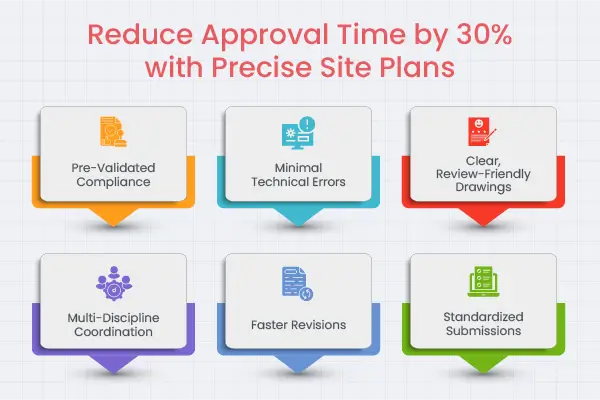
- Pre-Validated Compliance Before Submission
Accurate drafting integrates zoning rules, code requirements, and setbacks during the design stage. As compliance is already built in, plans bypass the major objection which eliminate one or more review cycles. - Zero or Minimal Technical Discrepancies
Precise alignment of elevations, dimensions, and layout to remove any inconsistencies across drawings. This prevents technical flags from reviewers, which are the primary cause of delays in approval. - Clarity That Reduces Review Time per submission
Clear annotations, proper layering, and standardized formats make plans quickly to interpret. Reviewers spend less time analyzing each sheet, directly shortening the overall review duration. - Integrated Multi-Disciplinary Coordination
When grading, drainage, utilities, and access plans are accurately coordinated, no conflicts arise. This avoids sequential approvals getting stalled due to interdependency issues. - Faster Turnaround on Required Revisions
If changes are needed, accurate base drawings allow quick and precise updates instead of reworking from scratch. This reduces resubmission timelines between the review cycles. - Standardized Submission Formats and Documentation
Following authority-specific formats and checklists ensure submissions pass initial screening without delays. This avoids administrative hold-ups before technical review even begins.
Common Mistakes That Delay City Approvals
City approvals are often less about complex regulations but more about avoidable errors in project submission.
Identifying these common mistakes can reduce the review cycle and avoid back and forth with authorities.
- Incomplete or Missing Information
Submitting drawings without important details like utility layouts, dimensions, or annotation triggers immediately review comments. Authorities cannot proceed with evaluation until all the required information is mentioned to avoid delays.
- Non-compliance with Zoning Regulations
Ignoring setbacks, restrictions, or land use rules to result in major revisions. Even minor deviations from local codes can push the project back into multiple review cycles.
- Inconsistent Data Across Drawings
Mismatching information between grading plans, site plans, and utility layouts creates confusion for reviewers. These inconsistencies need clarification and correction which may slow down the approval process.
- Poorly structured or unclear drawings
Lack of proper labeling, unclear symbols, or missing information make it difficult for authorities to interpret the plan. This increases the likelihood of queries and prolongs review timelines.
- Failed to Follow Submission Guidelines
Not adhering to specific formatting, file types, or documentation standards set by authorities results in outright rejection. Even technically correct plans can be delayed due to procedural non-compliance.
Ready to shorten your approval cycle?
Get compliance ready drafting with minimal revisions
Contact our experts today!Conclusion
Speeding up approvals isn’t about rushing submission but getting them right the first time. When your residential site plans are accurate, compliant, and aligned with local codes, the entire process moves faster. Quick feedback, fewer revisions, and smoother approvals follow naturally.
For the design and developer team, it means 30% faster clearance, control over timeline, and less uncertainty across the project lifecycle. The more precise your drafting will be the faster your projects get approved.
FAQs
How does accurate site plan drafting reduce the approval timeline by 30%?
Accurate drafting eliminates errors and compliance gaps before submission. This reduces review comments and resubmissions and allows authorities to process approval faster.
Why do inaccurate site plans lead to multiple approval cycles?
Inaccuracy creates inconsistencies and compliance issues that reviewers evaluate. Each issue needs clarification or revision, which triggers the additional review cycle and timelines.
What are the most critical elements in a site plan that impact approval speed?
The site plan includes correct setbacks, zoning compliance, drainage design, utility layouts, and clear annotation. Missing or incorrect details in these areas cause delays.
Can better drafting really reduce back-and-forth communication with authorities?
Yes, detailed and well-structured drawings answer most reviewer questions upfront. This reduces the need for clarification emails, meetings, and submissions.
How does coordination between drainage, grading, and utilities affect approval?
Poor coordination leads to design conflicts which separate departments flag separately. Accurate and integrated drafting prevents conflicts, enabling smooth and fast multi-department approvals.
What role does compliance play in speeding approvals?
Compliance ensures that plans meet all the regulatory requirements and standards from the start. When plans are code-aligned, they are less likely to face objection, which reduces approval time.
Are digital tools like CAD and BIM important for faster approvals?
Yes, these tools improve precision, reduce error, and enable better coordination across disciplines. They also help to maintain consistency, which is important for faster approval.
How do clear annotation and presentation impact the approval timelines?
Clear annotations, legends, and structural layout make it easier for reviewers to interpret the plan. This reduces ambiguity and speeds up the evaluation process.
Is outsourcing site planning a good strategy to accelerate approvals?
Outsourcing an experienced drafting team ensures high accuracy and faster turnaround time. Specialized teams are familiar with compliance standards, which help in reducing approval delays.
Pavan Mulik is the Vice President of Operations at Gsource Technologies and also serves as Account Manager for Structural and Mechanical Design. With extensive expertise in civil engineering, land surveying, and BIM, he excels at managing complex workflows and driving cross-functional collaboration. His strategic approach ensures smooth project execution at any scale. Outside work, he enjoys exploring landscapes and architectural marvels for inspiration.
Read More