Success Story: Multi-trade BIM Coordination


1. The Project at a Glance
2. Introduction: Setting the Stage
3. The Key Challenges in our Multi-Trade BIM Coordination Project
4. The Gsource Approach: From Inputs to Insights
5. The Final Outcome
6. Why Multi-Trade BIM Coordination Matters
7. Lessons Learned from the Project
8. Client Impact
9. Wrapping It Up
10. FAQs
The construction of high-rise buildings is a complex balancing act where multiple trades come together to create a safe, functional, and efficient structure. When even one piece of the puzzle is misaligned, the consequences can ripple across the entire project, causing rework, delays, and budget overruns. This is where multi-trade BIM coordination proves its value, ensuring that architecture, structure, and MEPF (Mechanical, Electrical, Plumbing, and Firefighting) systems all work in harmony.
This case study highlights how Gsource Technologies successfully delivered LOD 400 BIM modeling and multi-trade BIM coordination services for a 22-floor mixed-use residential tower in Illinois, enabling the client to move forward with confidence, accuracy, and efficiency.
1. The Project at a Glance
Category: MEPF Modeling and Detailing
Occupancy: Mixed-Use Residential High Rise
Year: 2023
Location: Illinois, USA
Floors: 22
Area: 14,000 sq. ft.
Input: Architectural & Structural 3D Models
Output: LOD 400 Revit Model, Clash Report, Shop Drawings (CAD + PDF)
2. Introduction: Setting the Stage
The client, a U.S.-based real estate developer specializing in high-rise residential projects, approached Gsource Technologies with a critical requirement: to develop a highly detailed LOD 400 BIM model for the project’s mechanical piping and ductwork.
With rising industry expectations for precision and faster project delivery, the client wanted more than just a model- they needed a comprehensive BIM solution that would include clash detection, iterative coordination across multiple trades, and precise shop drawings ready for fabrication and installation.
At its core, the project was about transforming architectural and structural inputs into a fully coordinated, constructible digital model that could minimize risks on-site.
3. The Key Challenges in our Multi-Trade BIM Coordination Project
Like most large-scale projects, this one came with its share of hurdles:
- Vertical Shaft Conflicts:
Coordinating MEPF systems across 22 floors required meticulous planning to prevent vertical shaft clashes between risers, ducts, and pipes.
- Limited Ceiling Spaces:
The design called for extensive ductwork and piping to fit into confined ceiling areas, while still meeting insulation and clearance requirements.
- Inconsistencies in Base Models:
Misalignments in the provided architectural and structural 3D models created integration challenges when routing mechanical systems.
- Time Sensitivity:
Maintaining accurate duct and pipe elevations across all 22 floors, while sticking to a tight timeline, meant that coordination needed to be both quick and precise.
Each of these challenges could have easily derailed progress, but with a structured multi-trade BIM coordination strategy, Gsource turned potential roadblocks into opportunities for smarter design and execution.
Our experts followed a structured process to ensure accuracy and coordination between multiple trades.
4. The Gsource Approach: From Inputs to Insights
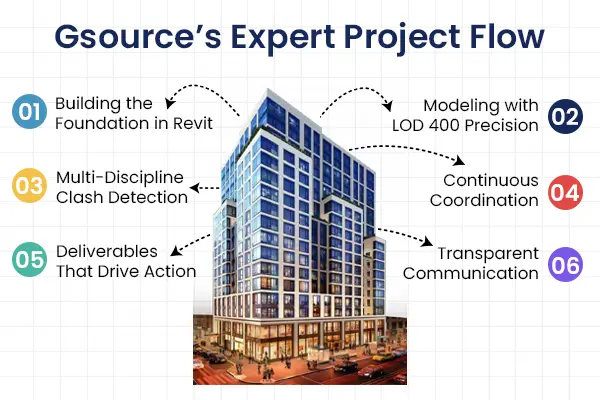
1. Building the Foundation in Revit
The architectural and structural models were imported into Revit to establish a clean foundation for MEPF modeling. Every element was carefully placed with exact dimensions, ensuring alignment with project specifications.
2. LOD 400 Precision
Mechanical piping and ductwork were modeled at LOD 400- the highest level of development before fabrication. This meant that fittings, joints, and clearances reflected real-world conditions, reducing guesswork during installation.
3. Multi-Discipline Clash Detection
Using Navisworks, Gsource ran iterative clash detection sessions. Issues such as overlapping risers or ductwork clashing with structural beams were resolved digitally long before they could appear on-site.
4. Continuous Coordination
Regular coordination meetings with stakeholders ensured that every design change or adjustment was addressed in near real-time. This collaborative approach prevented bottlenecks and fostered alignment across trades.
5. Deliverables That Drive Action
Once clashes were resolved, Gsource generated detailed shop drawings in CAD and PDF formats along with a clash report. These outputs were fabrication- and installation-ready, giving the client complete clarity.
6. Transparent Communication
Frequent updates kept the client informed of progress and empowered them to make quick decisions as design adjustments evolved.
5. The Final Outcome
By the end of the engagement, Gsource delivered:
- A fully coordinated LOD 400 Revit model covering all mechanical piping and ductwork across 22 floors.
- A clash-free report confirming that all MEPF systems aligned seamlessly with structural and architectural components.
- Precise shop drawings in CAD and PDF, enabling smooth fabrication and installation on-site.
The result of Gsource’s expert BIM coordination services? A project execution pathway with significantly reduced risk of rework, faster installation, and greater confidence for the client’s construction teams.
Wish to learn about this project in further detail?
Read More6. Why Multi-Trade BIM Coordination Matters
This project underscores a larger truth about construction today: it’s not enough to have great designs on paper. The real test lies in how well those designs integrate across trades. Without effective multi-trade BIM coordination, construction projects risk delays, disputes, and cost overruns.
Some of the biggest benefits realized through this case include:
- Reduced Rework: By resolving conflicts digitally, the team avoided costly on-site corrections.
- Time Savings: Faster approvals and seamless coordination accelerated delivery.
- Improved Accuracy: LOD 400 modeling ensured constructability and compliance with codes.
- Confidence in Execution: Shop drawings and clash reports eliminated ambiguity, empowering on-site teams to build with precision.
7. Lessons Learned from the Project
Every project is a learning opportunity, and this one offered several takeaways:
- Collaboration is Key:
Frequent coordination across disciplines is essential for avoiding last-minute surprises.
- LOD 400 is Worth the Investment:
High-detail modeling pays off by reducing downstream inefficiencies.
- Technology + Expertise = Success:
Tools like Revit and Navisworks are powerful, but it’s the expertise behind them that ensures smooth outcomes.
- Communication Builds Trust:
Regular client updates build transparency and confidence, strengthening relationships.
8. Client Impact
For the client, this project was more than just a modeling exercise. It was a proof of how outsourcing BIM coordination services can provide specialized expertise without overextending internal teams. By relying on Gsource, the client gained:
- Access to BIM experts who understand both design and site realities.
- Cost efficiency through minimized rework and optimized workflows.
- Faster turnaround that aligned with their tight project schedules.
Ultimately, this case demonstrated that BIM is not just about creating models; it’s about creating a smarter, more collaborative way to build.
9. Wrapping It Up
The 22-floor mixed-use residential tower in Illinois stands as a shining example of how multi-trade BIM coordination can transform complex projects into seamless executions. By combining LOD 400 precision, clash detection, and detailed shop drawings, Gsource Technologies delivered more than a model; they delivered peace of mind for both the client and the construction teams.
As construction projects continue to grow in scale and complexity, the importance of BIM coordination services will only increase. For developers, architects, and contractors alike, embracing BIM is not just about technology; it’s about reducing risk, saving time, and building smarter.
If you’re looking to bring the same level of precision and confidence to your projects, it may be time to explore how expert BIM outsourcing services can make a difference.
10. FAQs
How does Gsource Technologies use LOD 400 BIM modeling for high-rise residential projects?
Gsource delivers LOD 400 BIM modeling with fabrication-level detail, ensuring that every duct, pipe, and fitting in high-rise residential towers is accurate, coordinated, and ready for installation.
How do Gsource’s multi-trade BIM coordination services reduce construction rework and delays?
By using tools like Revit and Navisworks, Gsource runs iterative clash detection and cross-disciplinary coordination, helping clients avoid rework and stay on schedule in complex, multi-floor projects.
Why should developers outsource mechanical BIM modeling and coordination?
Outsourcing provides access to experienced BIM professionals who specialize in mechanical system modeling, delivering precise shop drawings and coordination without stretching internal resources.
How does Gsource’s clash detection process add value to MEPF BIM coordination?
Gsource’s detailed clash reports and resolution workflows ensure that all MEPF elements are integrated seamlessly with architectural and structural models, reducing on-site conflicts and improving build efficiency.
Pavan Mulik is the Vice President of Operations at Gsource Technologies, bringing extensive expertise in civil engineering, land surveying, and BIM. A true all-rounder, Pawan is passionate about architecture and excels in managing complex workflows while fostering dynamic team collaboration. His strategic approach ensures the successful execution of projects, no matter the scale. When he’s not overseeing operations, Pawan enjoys exploring new landscapes and architectural marvels, drawing inspiration from the world around him.
Read More