How Much Can You Save by Outsourcing MEP Drafting Services?

Table of Contents
Introduction: The Real Cost of MEP Drawings in Today’s Projects
Where Do MEP Drafting Costs Actually Come From?
In-House vs Outsourced MEP Drafting: A Practical Cost Comparison
Key Areas Where Outsourcing MEP Drafting Services Delivers Cost Savings
When Does Outsourcing MEP Drafting Services Make the Most Sense?
What to Look for in an MEP Drafting Partner
Conclusion: Turning MEP Drafting into a Scalable Advantage
FAQs
Introduction: The Real Cost of MEP Drawings in Today’s Projects
If you’re an MEP engineer or contractor, you already know this frustration: the drawings looked fine during design, but once installation begins, clashes, revisions, and RFIs start piling up.
The hidden cost? Time, rework, and shrinking margins. What is concerning is that 30-40% of site rework in building projects is due to MEP clashes alone.
So, the real question isn’t whether MEP drawings cost money. It’s how much they’re quietly costing your project – and how much you could save by doing them differently.
Where Do MEP Drafting Costs Actually Come From?
For many MEP engineers and contractors, drafting costs appear straightforward on paper. But in reality, the expenses often come from several hidden and operational factors across the project lifecycle.
Key contributors include:
Design complexity –
Large buildings, tight service spaces, and complex HVAC, electrical, and plumbing layouts require more detailed drafting and coordination.
Frequent design revisions –
Late architectural or structural changes can trigger multiple updates to MEP drawings, increasing drafting hours.
Coordination with other disciplines –
Aligning MEP systems with architectural and structural models takes time, especially in clash-prone areas.
Clash detection and rework –
Poorly coordinated drawings often lead to conflicts that require redrafting and model updates.
Documentation requirements –
Preparing shop drawings, installation layouts, and detailed schedules adds to the overall drafting effort.
Project timelines –
Tight deadlines often require larger drafting teams or extended working hours.
Understanding these cost drivers helps project teams identify where efficiency improvements- and cost savings- are truly possible.
In-House vs Outsourced MEP Drafting: A Practical Cost Comparison
Hiring an MEP drafting partner might help an organization save massively on costs as compared to maintaining an in-house team. Let’s do a quick comparison to understand how:
| Factor | In-House MEP Drafting | Outsourced MEP Drafting |
|---|---|---|
| Hiring & Training Costs | High recruitment and training expenses | No hiring or onboarding costs |
| Software & Infrastructure | Requires investment in CAD/BIM licenses and hardware | Service provider manages tools and infrastructure |
| Scalability for Large Projects | Limited by internal team capacity | Easily scalable with larger drafting teams |
| Turnaround Time | Slower during peak workloads | Faster delivery with dedicated resources |
| Flexibility | Difficult to adjust team size quickly | Resources scale up or down as needed |
| Project Overheads | Includes salaries, benefits, office space | Pay only for the required scope |
| Access to Specialized Expertise | Limited to in-house skill sets | Access to experienced drafting specialists |
| Overall Cost Efficiency | Higher long-term operational costs | Typically more cost-effective for many projects |
Note: Cost savings vary depending on project complexity, volume of drawings, and coordination requirements.
Key Areas Where Outsourcing MEP Drafting Services Delivers Cost Savings
For MEP engineers and contractors, outsourcing drafting isn’t just about reducing workload- it’s about controlling project costs while maintaining quality and speed. Studies show that rework alone can consume 5-15% of total construction costs, often due to coordination errors and documentation gaps.
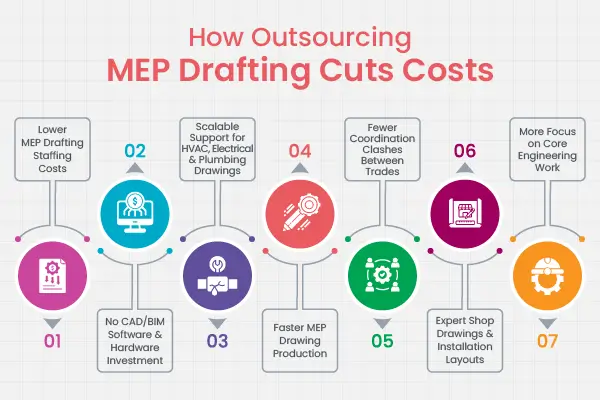
Here are the key areas where outsourcing MEP drafting services can deliver measurable savings:
Lower Costs for MEP CAD and BIM Drafting Teams
Hiring in-house MEP drafters requires recruitment, onboarding, salaries, and long-term overheads. Outsourcing removes these fixed staffing costs and allows firms to pay only for the drafting capacity required.
Reduced Investment in MEP Drafting Software and Hardware
MEP projects depend on specialized tools like Revit MEP, AutoCAD, and BIM coordination platforms. Outsourcing partners typically manage these licenses and high-performance systems.
Scalable Drafting Support for HVAC, Electrical, and Plumbing Systems
Large buildings generate extensive duct, piping, and cable tray layouts. Outsourcing allows teams to quickly scale drafting resources during peak project phases.
Faster Production of MEP Drawings
Dedicated external teams focus entirely on documentation- equipment layouts, service routing, and installation drawings- improving turnaround time.
Reduced Coordination Clashes Between Trades
MEP systems account for a large share of coordination conflicts in buildings, often causing about 35% of site rework when discovered late. Early coordination in drafting significantly reduces these risks.
Specialized Support for Shop Drawings and Installation Layouts
Detailed deliverables such as duct shop drawings, piping isometrics, and electrical layouts require specialized expertise that outsourcing teams can provide.
Greater Focus on Engineering and Project Delivery
When drafting production is outsourced, engineers can focus on system design, coordination meetings, and site execution.
When Does Outsourcing MEP Drafting Services Make the Most Sense?
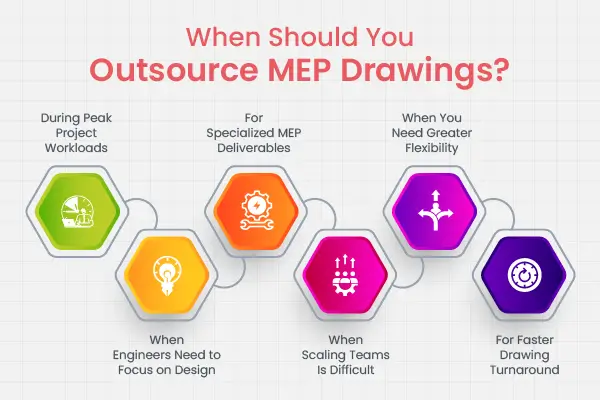
For many MEP engineers and contractors, the question isn’t whether to outsource drafting- it’s when it actually makes the most practical and financial sense. In reality, outsourcing becomes most valuable during phases when internal teams are stretched or when specialized documentation is required quickly.
One common scenario is during peak project workloads. Large commercial or infrastructure projects can generate hundreds of MEP drawings in a short timeframe. Instead of rushing internal teams or delaying deliverables, outsourcing helps maintain documentation speed without sacrificing accuracy.
It also makes sense when your in-house team needs to focus on engineering rather than drafting. Engineers are most valuable when they’re solving design challenges, coordinating with consultants, and supporting construction- not spending excessive time producing drawings.
Another situation where outsourcing proves useful is when projects require specialized deliverables, such as detailed shop drawings, coordinated MEP layouts, or installation-ready documentation. External drafting teams often have dedicated expertise in producing these outputs efficiently.
Outsourcing is also helpful when scaling teams quickly becomes difficult. Hiring, training, and onboarding new drafters takes time, whereas outsourcing provides immediate access to skilled resources.
Ultimately, outsourcing MEP drafting services works best when firms need flexibility, faster turnaround, and reliable documentation support while keeping project costs predictable and under control.
What to Look for in an MEP Drafting Partner
Choosing the right MEP drafting partner can make a significant difference in project timelines, coordination efficiency, and overall documentation quality. Here are a few key factors to consider:
Proven Industry Experience
Look for a partner with extensive experience supporting MEP projects across residential, commercial, industrial, and infrastructure developments.
Strong CAD and BIM Capabilities
The team should be proficient in leading platforms such as AutoCAD, Revit, and BIM workflows to produce accurate, coordinated drawings.
Standards-Aligned Documentation
Drafting outputs should follow applicable building codes, project specifications, and industry standards to ensure compliance and consistency.
Dedicated Project Teams
Having a committed drafting team ensures responsive communication, quicker turnaround times, and better alignment with project requirements.
Structured QA/QC Processes
Reliable partners follow structured quality checks to maintain dimensional accuracy and documentation consistency before delivery.
Coordination with Other Trades
The drafting team should be capable of coordinating mechanical, electrical, and plumbing layouts with structural and architectural systems.
Scalable Support for Large Projects
A good partner should easily scale resources to meet demanding schedules and project workloads.
Conclusion: Turning MEP Drafting into a Scalable Advantage
Outsourcing MEP drafting is no longer just a cost-cutting strategy- it’s a way to build flexibility and scale into your operations. With the right partner, teams can handle fluctuating workloads, accelerate project timelines, and maintain high-quality, coordinated drawings without overburdening internal resources. It also allows engineers and project managers to focus on higher-value tasks like design optimization and client coordination.
As projects grow more complex, having access to skilled drafting support on demand becomes a competitive advantage. The key lies in choosing an MEP drafting partner who understands your standards, timelines, and project requirements.
FAQs
How does outsourcing MEP drafting services reduce project costs?
Outsourcing MEP drafting services eliminates the need for in-house hiring, training, and infrastructure while reducing rework through experienced drafting support.
Is outsourcing suitable for small or only large projects?
Outsourcing is scalable, making it suitable for both small projects and large, complex developments.
How do outsourced teams ensure drawing accuracy?
Experienced teams follow standardized workflows, QA processes, and coordination checks to deliver precise and reliable drawings.
Will outsourcing affect project timelines?
In most cases, it speeds up delivery by providing additional resources and enabling parallel workflows.
How do I choose the right MEP drafting partner?
Look for proven experience, strong communication, quality assurance processes, and the ability to align with your project standards.