How Minor Errors in Steel Connection Details Lead to Major Delays

Table of Contents
The Illusion of “Minor” Errors
What Causes Major Delays in Structural Steel Projects
- Case 1: Missing or Ambiguous Steel Connection Dimensions
- Case 2: Steel Connections That Ignore Erection Access
- Case 3: Revision Mismatch Between GA and Steel Connection Drawings
The Compounding Effect of Steel Delays
Preventing the Next Delay in Steel Projects
In Conclusion: The Real Cost of Minor Errors
FAQs
In steel detailing, the word “minor” is dangerously misleading.
A missing dimension. A bolt callout that seems “obvious.” A connection that looks fine on screen. None of these raise red flags during design reviews. After all, the drawings are approved, the model clashes are resolved, and the schedule is tight.
What could really go wrong? Plenty!
The Illusion of “Minor” Errors
Steel doesn’t fail politely. It fails publicly- on the shop floor, at the site gate, or worse, mid-erection. What looked like a small oversight in a steel connection detail suddenly becomes a fabrication hold, a field workaround, or an RFI that stops progress across multiple trades.
The illusion comes from scale. A two-millimeter discrepancy or a missing erection note feels insignificant on paper. On-site, it can stall cranes, crews, and sequencing for days. And once steel pauses, everything downstream feels it.
In steel detailing, there are no minor errors- only delayed consequences waiting for gravity, tolerance, and reality to weigh in.
What Causes Major Delays in Structural Steel Projects
A small oversight in detailing can quietly grow into a major site issue. Steel projects rarely stall because of major structural failures. More often, delays begin with minor connection errors that pass coordination and approval stages unnoticed, until fabrication or erection brings them to light.
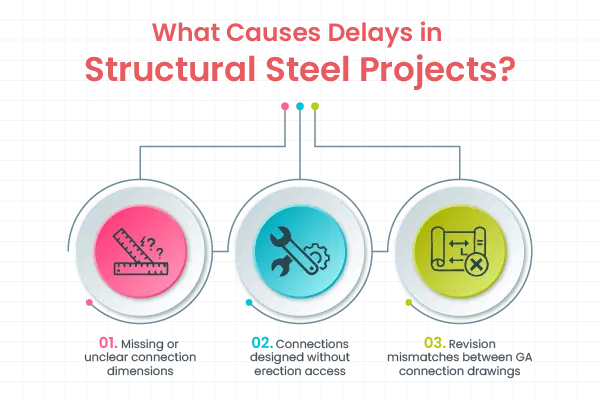
Case 1: Missing or Ambiguous Steel Connection Dimensions
The errors can seem quite small, such as a missing dimension, a bolt callout that seems “obvious,” or a steel connection that looks fine on screen. Nothing raises concern during review. The drawings are stamped, the model is coordinated, and fabrication begins. But then things start to spiral on site:
- The shop team notices a missing edge distance on a base plate.
- Bolt spacing is shown, but no clear reference point is defined.
- The weld size is indicated, yet the weld length is unclear.
- The GA drawing and connection detail show slight dimensional variation.
Then, the disruption follows- the machine stops, an RFI is submitted, and the engineer revisits the model. Clarifications circulate between teams. What appeared to be a minor omission now affects cutting, drilling, and delivery sequencing. A small gap in a connection detail quietly turns into a measurable delay.
Case 2: Steel Connections That Ignore Erection Access
On the drawing, the steel connection works. Bolt sizes are correct. Plate thickness checks out. The analysis is sound. Everything looks structurally perfect. But a closer look at the drawings reveals where it all goes wrong:
- Bolts are positioned too close to adjacent members.
- There’s no clearance for impact wrench access.
- A column splice is detailed without considering crane positioning.
- Field welding is specified in a location with limited site reach.
When the structural steel arrives on site, the crew attempts installation. But the tools don’t fit, and the access is restricted, which leads to temporary adjustments being discussed. The work slows down, and alternative erection methods are considered. Site modifications are proposed.
The connection was structurally correct, but practically unbuildable. And that’s when the schedule begins to slip.
Case 3: Revision Mismatch Between GA and Steel Connection Drawings
A revised grid shift. A last-minute column size update. A connection detail revised – but not everywhere. The GA drawing carries Revision 3, but the connection sheet still shows Revision 2. These are the sort of silly errors that can cost you your project.
- The beam size is updated in GA, but the connection plate remains unchanged.
- Bolt quantities differ between sheets.
- A stiffener is added in one view but is missing in another.
- Dimensions no longer align with the updated framing layout.
What happens next? Fabrication proceeds using one set, and erection references another. The discrepancy is discovered on site, and field crews pause as clarifications begin. There’s actually no major design flaw; just a revision mismatch. And yet, cutting, re-drilling, and schedule adjustments follow – all from drawings that were technically “issued.”
Tired of catching errors in your steel projects?
Our detailing teams prevent minor errors from becoming major delays.
The Compounding Effect of Steel Delays
A steel delay rarely stays contained within the steel package. What begins as a small clarification on a steel connection detail or a minor dimensional conflict in fabrication drawings gradually starts affecting everything downstream. Structural steel sits at the core of most building schedules. When it slows, the trades that depend on it have no choice but to wait or reshuffle.
A delayed beam delivery can push back deck installation. That pushes concrete pours. That affects curing timelines. MEP rough-ins shift. Façade systems cannot proceed as planned. Site logistics become harder to manage. Crane bookings extend. Labor allocations change. None of these impacts appears dramatic in isolation, but together they create measurable schedule drift.
The financial effect compounds just as quickly. Extended equipment rentals, remobilization costs, additional supervision hours, and potential liquidated damages begin to surface. Teams that were aligned at the start of the project now spend time coordinating recovery plans instead of progressing work.
What makes this especially challenging is that the original trigger may have been minor – a missed dimension, an unclear weld length, or a revision mismatch. The issue was small. The consequence is not. In steel construction, delays do not move linearly. They multiply.
Preventing the Next Delay in Steel Projects
Delays in structural steel projects rarely happen overnight. They build quietly- through small coordination gaps, unclear approvals, rushed detailing, and reactive problem-solving. Preventing the next delay requires structured, proactive control across design, detailing, fabrication, and site execution.
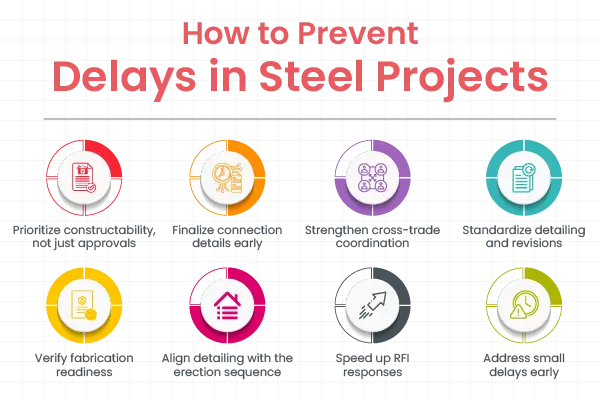
Here’s how leading project teams stay ahead:
Start With Constructability, Not Just Approval
Approved drawings don’t guarantee buildability. Early constructability reviews reduce fabrication conflicts and site improvisation.
Lock Down Connection and Interface Details Early
Unresolved connection designs and discipline overlaps are common delay triggers. Finalizing these upfront prevents downstream RFIs.
Strengthen Model Coordination Across Trades
Steel interacts with MEP, concrete, and façade systems. Proactive clash detection avoids last-minute redesign and rework.
Standardize Detailing and Revision Control
Clear naming conventions, version tracking, and structured approvals reduce confusion between IFC, shop, and revised drawings.
Validate Fabrication Readiness Before Release
Checking bolt types, weld symbols, member sizes, tolerances, and edge distances avoids shop-floor stoppages.
Align Detailing Output with Fabrication Sequencing
Shop drawings should reflect erection priorities and site phasing, not just design logic.
Improve RFI Response Cycles
Fast, structured RFI resolution keeps fabrication moving and prevents schedule compounding.
Monitor Small Delays Before They Compound
A two-day detailing delay can become a two-week erection issue. Track early slippages before they escalate.
Steel projects don’t fail because of one big mistake. They slow down because of many small ones left unmanaged. Prevention starts with clarity, coordination, and disciplined execution.
In Conclusion: The Real Cost of Minor Errors
In steel projects, what begins as a small drafting oversight can lead to shop-floor stoppages, material reorders, RFIs, schedule slippage, and strained site coordination. The real cost isn’t just the correction- it’s the compounded impact on timelines, labor productivity, and stakeholder confidence.
Approved drawings alone are not enough. True project control comes from constructability-focused detailing, disciplined revision management, strong multi-trade coordination, and fast, structured communication between design, fabrication, and site teams. When these controls are proactive rather than reactive, projects move predictably and profitably.
Steel programs succeed not because errors never occur, but because risks are identified early and resolved before they escalate. In high-volume, fast-track environments, precision isn’t optional; it’s the difference between steady progress and preventable delay.
FAQs
Why are steel connection details so critical to project timelines?
Connections govern load transfer, fabrication accuracy, and erection sequencing, making them central to structural stability and schedule flow.
What are common minor errors in steel connection detailing?
Typical issues include incorrect bolt grades, missing weld symbols, misaligned plates, tolerance conflicts, and inconsistent revision references.
How can a small detailing error cause major site delays?
Even minor errors can halt fabrication, trigger RFIs, require material rework, and disrupt erection sequencing.
How do connection errors impact fabrication shops?
Errors often lead to shop-floor stoppages, remanufacturing, wasted material, and production bottlenecks across multiple assemblies.
What role does coordination play in preventing connection-related delays?
Early multi-trade coordination reduces clashes with MEP, concrete embeds, and architectural elements before steel reaches site.
How can project teams prevent recurring steel detailing issues?
Through structured QA/QC, constructability reviews, disciplined revision control, and faster RFI resolution cycles.
Pavan Mulik is the Vice President of Operations at Gsource Technologies, bringing extensive expertise in civil engineering, land surveying, and BIM. A true all-rounder, Pawan is passionate about architecture and excels in managing complex workflows while fostering dynamic team collaboration. His strategic approach ensures the successful execution of projects, no matter the scale. When he’s not overseeing operations, Pawan enjoys exploring new landscapes and architectural marvels, drawing inspiration from the world around him.
Read More