BIM Coordination vs. Traditional Coordination: A Cost/Benefit Analysis

1. Why a Lack of Coordination Breaks Projects
2. What is Traditional Coordination?
3. What is BIM Coordination?
4. Comparison: Traditional vs. BIM Coordination
5. Benefit Analysis: Why BIM Wins
6. Real-World Example
7. ROI Beyond Cost Savings
8. Conclusion: The Smarter Investment
9. FAQs
1. Why a Lack of Coordination Breaks Projects
Projects don’t fail because of bad designs; they fail because good designs don’t talk to each other. Even the most experienced teams struggle when drawings clash, updates go unnoticed, and coordination turns into chaos. From misplaced ducts to misaligned beams, these small disconnects can snowball into costly rework and endless delays.
It’s not that professionals aren’t doing their best – it’s that traditional coordination methods often leave too much room for error. That’s exactly where BIM coordination steps in, bringing everyone and everything onto the same digital page for faster decisions and far fewer on-site surprises.
2. What is Traditional Coordination?
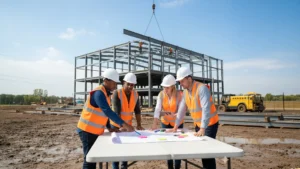
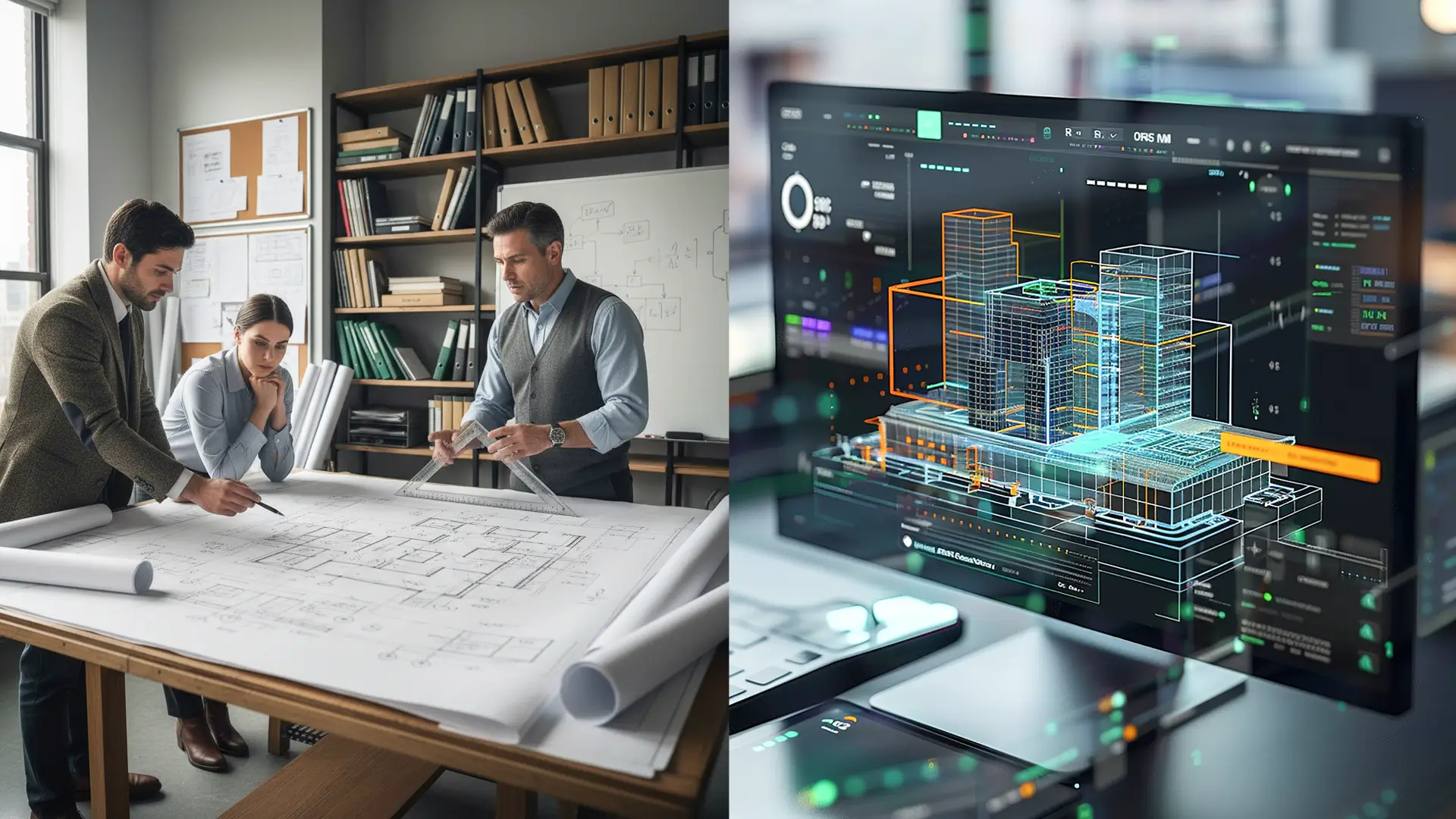
Imagine a meeting with architects, project engineers, contractors, and consultants, all gathered to review and discuss the 2D drawings of a project. They would study the drawings visually and conduct manual clash detection. This caused a serious issue of clashes being missed or identified late, leading to expensive rework and project delays.
Traditional coordination was thus time-consuming, tedious, and prone to errors. It also led to miscommunication, increased blame, and a lack of accountability between different disciplines, especially in multi-trade construction projects. Without a shared digital model, teams often worked in silos, making updates inconsistently and relying on assumptions rather than real-time data – the perfect recipe for confusion on-site.
3. What is BIM Coordination?
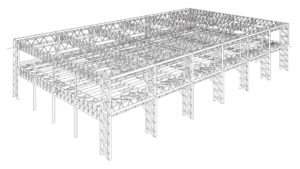
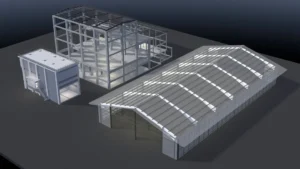
BIM coordination is a process where teamwork meets technology. It brings architects, engineers, and contractors onto the same digital page, literally, inside one unified 3D model created through architectural design processes. Instead of on-site clash detection (and dealing with costly rework), teams can spot and fix them virtually before a single brick is laid. Think of it as a construction dress rehearsal where every beam, pipe, and duct finds its perfect place.
By aligning design intent with real-world execution, our BIM coordination procedures turn multi-trade construction confusion into clarity, reduce delays, and keep everyone, from designers to builders, working in perfect sync. It’s smarter, faster, and far less stressful than the old way of doing things.
4. Comparison: Traditional vs. BIM Coordination
| Aspect | Traditional Coordination | BIM Coordination |
|---|---|---|
| Process | Manual review of 2D drawings across disciplines | Real-time integration of all disciplines within a unified 3D model |
| Clash Detection | Clashes identified late during construction | Clashes detected and resolved virtually before construction begins |
| Accuracy | Prone to human error and misinterpretation | Highly accurate, data-driven coordination |
| Collaboration | Disconnected communication between teams | Centralized collaboration with cloud-based model sharing |
| Time Efficiency | Time-consuming due to multiple manual revisions | Faster decision-making through automated updates and model insights |
| Cost Impact | Leads to frequent rework and budget overruns | Reduces rework by up to 90%, saving significant project costs |
| Visualization | Limited visualization through 2D drawings | Immersive 3D visualization for better spatial understanding |
| Accountability | Difficult to track design ownership and updates | Transparent change tracking with version history |
| Data Management | Paper-based or fragmented digital files | Centralized, accessible BIM database |
| Outcome | Increased project risks and delays | Streamlined workflow, improved quality, and timely delivery |
5. Benefit Analysis: Why BIM Wins
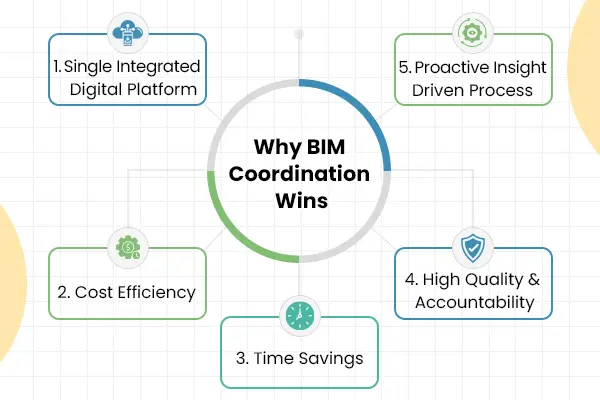
Unlike traditional coordination, which relies heavily on manual checking and fragmented communication, BIM coordination services bring every stakeholder – architects, engineers, contractors, and fabricators – onto one integrated digital platform.
The biggest win is cost efficiency. By identifying design clashes early in the 3D environment, BIM Modeling helps prevent expensive rework during multi-trade construction. Studies show it can reduce rework costs by up to 90%. This early detection also ensures materials, time, and labor are used optimally, cutting down on project waste.
Time savings follow naturally. With automated updates and real-time collaboration, design iterations happen faster, and approvals move seamlessly across disciplines. BIM’s visual clarity also minimizes misunderstandings and RFIs (Requests for Information), keeping projects on track and within schedule.
Beyond cost and time, quality and accountability see major gains. Every element in a BIM model is data-rich and traceable, ensuring accurate documentation and informed decision-making throughout the lifecycle of a building.
Ultimately, BIM coordination turns coordination from a reactive, error-prone task into a proactive, insight-driven process, one that not only saves money but also builds smarter, stronger, and more sustainable projects.
6. Real-World Example: The Benefits of BIM Coordination
The 2019 fire at Notre-Dame Cathedral in Paris caused severe damage to this world-famous heritage structure. Rebuilding it posed massive challenges due to its complex geometry, fragile historical elements, and the need for precise restoration. Traditional coordination methods alone would have made the process slow, error-prone, and risky.
How BIM Coordination helped:
- Integrated all disciplines – architects, engineers, and heritage specialists – into a single 3D model.
-
Incorporated historical plans, laser scans, point-cloud classification, and documentation for accurate reconstruction.
- Enabled virtual clash detection and early identification of structural issues.
- Facilitated real-time collaboration across multiple teams, ensuring coordinated decision-making.
- Preserved historical integrity while streamlining construction workflow.
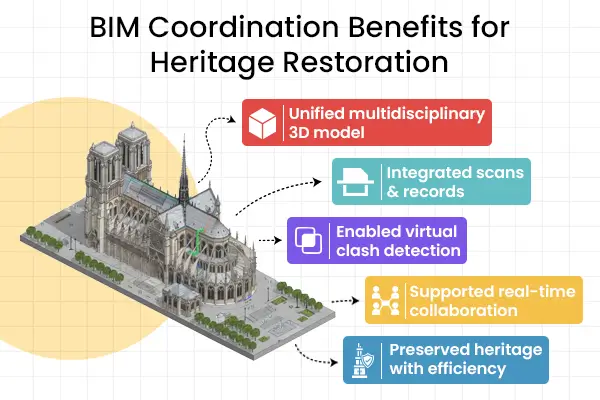
By leveraging BIM, the reconstruction team could reduce errors, prevent costly rework, and accelerate the rebuilding process. This digital coordination not only safeguarded the cathedral’s heritage but also demonstrated the power of BIM in tackling highly complex projects, proving it to be an essential tool for precision, efficiency, and collaboration in modern construction.
7. ROI Beyond Cost Savings
While the financial benefits of BIM coordination services are clear, the true ROI extends far beyond just saving money. Here’s how BIM coordination services add value across multiple dimensions:
- Reduced Rework and Errors: Early clash detection prevents costly mistakes on-site, saving both time and materials.
- Faster Project Delivery: Real-time updates and automated workflows accelerate approvals and design iterations, shortening project timelines.
- Enhanced Collaboration: Centralized models allow architects, engineers, and contractors to work together seamlessly, reducing miscommunication and misunderstandings.
- Improved Quality and Safety: Data-rich models ensure precise execution, enhancing structural integrity and minimizing on-site risks.
- Better Decision-Making: Detailed visualizations and analytics provide stakeholders with actionable insights, enabling smarter design and construction choices.
- Sustainability Gains: Optimized material usage and clash-free designs contribute to lower waste and environmentally responsible building practices.
By integrating these benefits, BIM coordination services by leading firms like Gsource Technologies deliver measurable ROI not just in cost savings, but in efficiency, quality, and long-term project success.
8. Conclusion: BIM Coordination, the Smarter Investment
Investing in BIM coordination services is more than a technological upgrade – it’s a strategic decision that transforms how projects are designed, managed, and executed. By integrating all disciplines into a single, data-rich model, teams can detect clashes early, streamline workflows, and improve collaboration across stakeholders. The result is faster project delivery, reduced rework, and enhanced quality, all while maintaining cost efficiency in multi-trade construction projects.
Beyond financial savings, BIM coordination empowers better decision-making, increases accountability, and supports sustainable construction practices. For contractors, engineers, and architects, adopting BIM isn’t just a tool; it’s a smarter investment in precision, efficiency, and long-term project success.
9. FAQs
What are the main differences between BIM coordination and traditional coordination methods in construction?
BIM coordination integrates all design disciplines into a single 3D model, allowing real-time clash detection and collaboration. Traditional methods rely on 2D drawings and manual checks, which are more error-prone and time-consuming.
How do BIM coordination services help reduce rework and construction delays on large projects?
By identifying design clashes and conflicts virtually before construction, BIM coordination services prevent costly on-site rework. This proactive approach saves time, reduces material waste, and keeps projects on schedule.
Can BIM coordination improve collaboration between architects, engineers, and contractors?
Yes. BIM centralizes project data, enabling seamless communication and shared access to updated models. Teams can make informed decisions quickly, reducing miscommunication and improving accountability.
What is the ROI of implementing BIM coordination beyond just cost savings?
BIM provides ROI through faster project delivery, improved design quality, enhanced safety, and sustainable construction practices. It also supports better decision-making and long-term efficiency across project lifecycles.
A BIM Coordinator at Gsource Technologies, Manoj Undure is focused on ensuring accuracy and efficiency in MEPF models. With a keen eye for detail, he specializes in coordinating multi-disciplinary teams, managing model integrity, and producing clash-free designs that save both time and cost. Skilled in working across various BIM platforms, Manoj bridges the gap between design intent and execution, making collaboration smoother for all stakeholders. Outside of work, Manoj enjoys exploring new tools and techniques in digital construction.
Read More