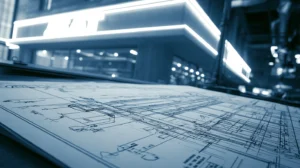
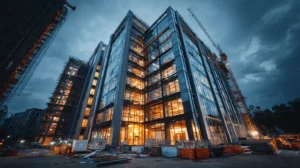
Why Structural Steel Projects Fail Despite ‘Approved’ Drawings

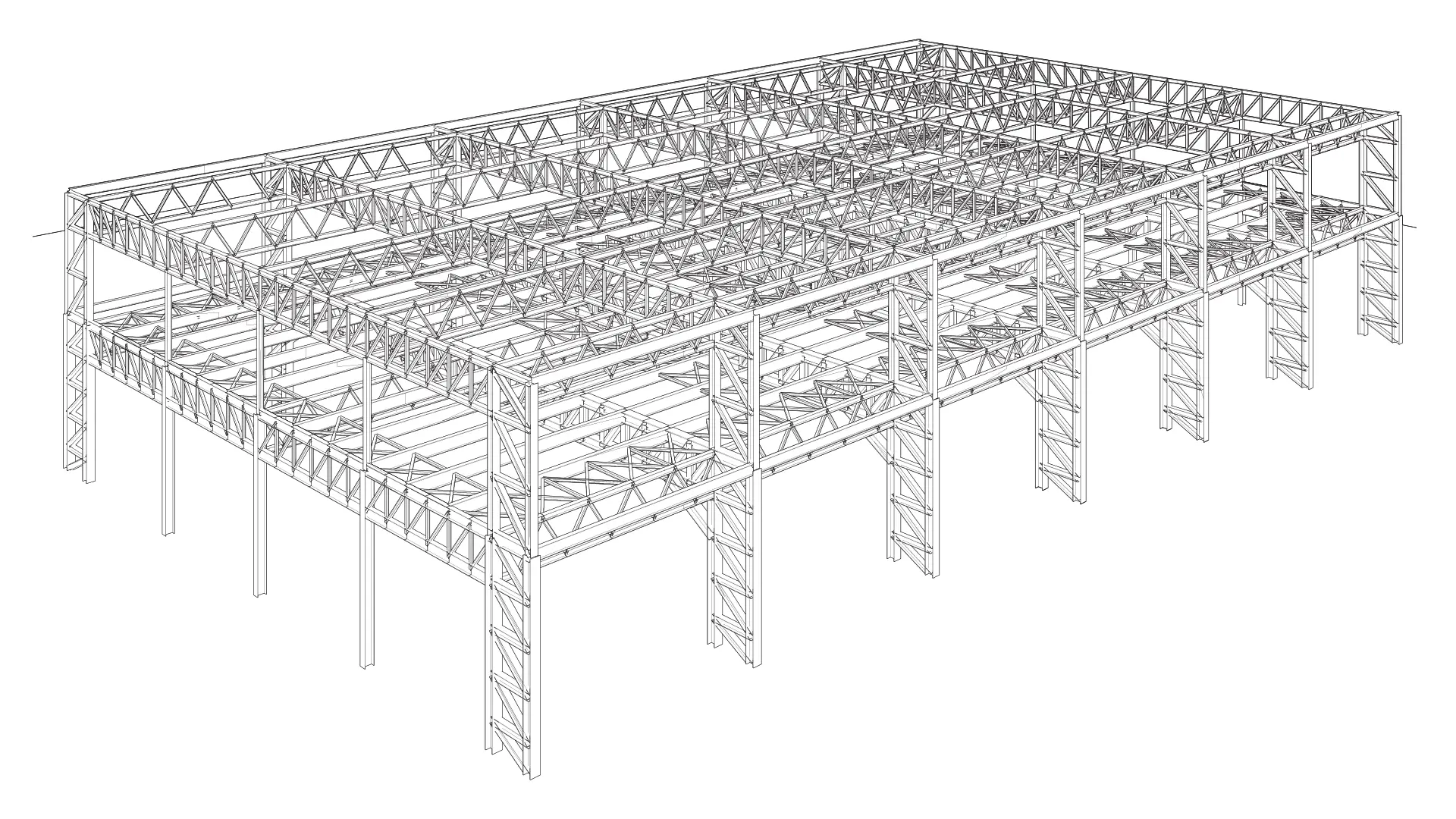
Table of Contents
The Picture-Perfect Problem
Why Approved Structural Steel Drawings Fail
The Picture-Perfect Problem
On paper, everything looks perfect.
The structural steel drawings are stamped “Approved.” The design intent is clear. Everyone has signed off. And yet, once fabrication begins or steel starts going up on site, things unravel. Members don’t align. Connections don’t work. RFIs explode. Schedules slip. Costs climb.
So, what went wrong?
Why Approved Structural Steel Drawings Fail
The uncomfortable truth is this: an “approved” drawing isn’t always a buildable drawing. Approval usually confirms that the design meets intent, not that it’s fully coordinated, fabrication-ready, or practical in the real world. Beneath those clean lines and neatly labeled sections, hidden gaps often exist. And steel has zero tolerance for assumptions.
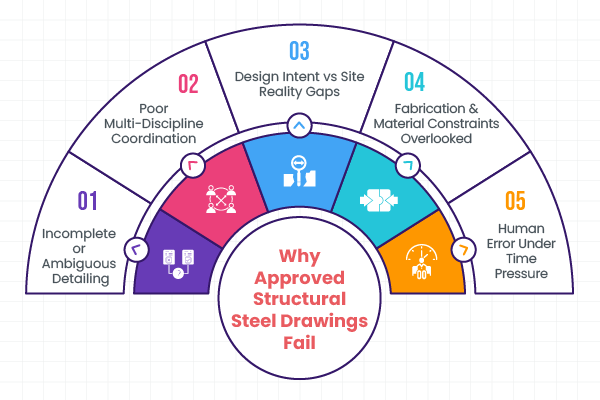
Here’s where seemingly perfect structural steel detailing drawings fall short- and why those steel construction projects fail.
-
Inadequate Detailing and Coordination Gaps
Note this down- approval doesn’t guarantee completeness.
-
Missing or vague detailing:
A beam might be shown, but connection logic, weld sizes, bolt grades, or tolerances may be glossed over or left “to be determined.” These gaps only surface once fabrication starts when it’s already expensive to fix.
-
Poor cross-discipline coordination:
Structural steel process may look fine in isolation, but once overlaid with architectural or MEP plans, clashes emerge- pipes through beams, ducts fighting bracing, or access issues no one accounted for.
-
Scale and interpretation issues:
Small, unlabeled dimensions or unclear references can be misread during detailing, resulting in steel that simply doesn’t fit when it arrives on site.
-
-
Communication Breakdowns and Revision Chaos
This is where most steel projects quietly derail. Approved drawings don’t fail here. Processes do.
-
Outdated structural steel drawings in circulation:
The shop might be fabricating from Revision A while the site is building from Revision D. The result? Rework, scrap, and costly delays.
-
Siloed teams:
When detailers, fabricators, and erectors aren’t in constant alignment, real-world constraints like lifting limitations or site access never make it back into the drawings.
-
-
The Gap Between Design and Reality
Steel structures don’t exist in a vacuum, and drawings sometimes pretend they do.
-
Unaccounted site conditions:
Soil behavior, tolerances in concrete work, uneven foundations, or restricted crane access can all render an approved design difficult or impossible to execute.
-
Over-reliance on software:
BIM tools can generate drawings that are technically correct but practically flawed. Without experienced eyes reviewing constructability, “looks right” can turn into “won’t work” fast.
-
-
Fabrication and Material-Level Issues
Let’s face it- even the best drawings can’t save poor execution.
-
Incorrect material grades or defects:
Substituting steel grades or missing quality checks compromises structural performance in steel projects.
-
Fabrication errors:
Improper welds, misaligned holes, or incorrect bolt tightening, often due to rushed schedules or untrained labor, can lead to failures that drawings alone can’t prevent.
-
-
Human Factors and Process Pressure
Did you know that this is the silent contributor behind most failures?
-
Rushed approvals:
Tight timelines often mean reviews are done to “move things forward,” not to interrogate buildability deeply.
-
Lack of experienced supervision:
Even flawless drawings need skilled oversight on site to ensure steel is erected as intended.
-
Uncontrolled changes:
Informal tweaks after approval- done without full engineering review- can compromise the entire structural system.
-
Final Thought: Approval Isn’t the Finish Line
In steel construction projects, approval is the starting point- not the safeguard. True success lies in coordinated detailing, disciplined revision control, constructability reviews, and constant communication between design, fabrication, and site teams.
Because when steel fails, it’s rarely due to one big mistake; it’s usually a series of small assumptions hiding beneath an “approved” drawing.
FAQs
If structural steel drawings are approved, why do steel issues still occur?
Approval confirms design intent, not fabrication readiness or site practicality. Turning approved drawings into constructible, coordination-checked steel details is essential.
What’s the difference between design drawings and fabrication-ready drawings?
Design drawings show what to build; fabrication drawings define how to build it. Experienced companies like Gsource Technologies bridge this gap with shop-ready steel detailing.
How can coordination errors be avoided before fabrication starts?
Early multi-discipline coordination and clash detection are critical. Use detailed coordination workflows to catch conflicts before steel is cut.
Why do revisions cause so much rework in steel construction projects?
Uncontrolled revision flow leads to outdated drawings reaching the shop or site. It is important to follow strict revision tracking to keep all teams aligned.
Can BIM alone prevent steel project failures?
BIM is a tool, not a safeguard, without constructability expertise. Gsource combines BIM with real-world fabrication and erection experience.
When should steel detailing experts be involved in a project?
Ideally, steel detailing experts should be involved before fabrication begins, not after issues surface. Gsource supports projects early to reduce RFIs, rework, and delays.
What are the 5 stages of structural design?
Concept design, preliminary analysis, detailed design, construction documentation, and construction support through RFIs and revisions.
What do structural detailers do?
Structural detailers convert design drawings into fabrication- and erection-ready shop drawings, ensuring accuracy, coordination, and constructability.
Who typically prepares shop drawings?
Shop drawings are usually prepared by structural steel detailers, working for fabricators or specialized detailing consultants.
Pavan Mulik is the Vice President of Operations at Gsource Technologies and also serves as Account Manager for Structural and Mechanical Design. With extensive expertise in civil engineering, land surveying, and BIM, he excels at managing complex workflows and driving cross-functional collaboration. His strategic approach ensures smooth project execution at any scale. Outside work, he enjoys exploring landscapes and architectural marvels for inspiration.
Read More