How Large Architecture Companies Benefit from Outsourcing Architectural Drafting


1. Why Large Architecture Firms Are Rethinking In-House Drafting Teams
2. What Outsourcing Architectural Drafting Really Means for AEC Enterprise Companies
3. How Outsourcing Architectural Drafting Helps Large Firms Scale Faster
4. Choosing the Right Outsourcing Partner for Large Architecture Firms
5. The Best Engagement Models for Large Architecture Practices
6. Is Outsourcing Architectural Drafting Right for Your Enterprise Company in 2026?
7. FAQs
1. Why Large Architecture Firms Are Rethinking In-House Drafting Teams
Large architecture firms are delivering more projects than ever, but internal drafting teams are struggling to keep pace. Rising workloads, tighter timelines, and growing documentation complexity are exposing the limits of fixed in-house capacity, pushing firms to rethink how drafting support is structured and scaled.
These are the two main reasons why architecture firms are considering alternatives to in-house teams:
-
Scaling Projects Becomes Harder Than Winning Them
Winning new projects feels great- until the delivery pressure sets in. As portfolios expand, firms often face bottlenecks in documentation, redlines, and permit sets. Scaling drafting capacity quickly, without compromising standards or burning out teams, becomes harder than securing the work itself.
-
The Hidden Cost of Overloaded Internal Drafting Teams
Overloaded drafting teams lead to more than missed deadlines. Quality slips, revisions increase, and senior designers spend time fixing drawings instead of designing. Add overtime, hiring delays, and attrition, and the true cost of relying solely on in-house drafting quietly erodes margins and morale. Outsourcing can offer significant cost savings, which is why about 70% of US firms are opting for it.
2. What Outsourcing Architectural Drafting Really Means for AEC Enterprise Companies
For AEC enterprise companies, outsourcing architectural drafting isn’t about cutting corners; it’s about gaining controlled scale. With complex projects, tight governance, and multiple stakeholders, maintaining large in-house teams becomes inefficient. Strategic outsourcing provides flexible capacity, specialized expertise, and consistent documentation support without adding long-term overhead or operational risk.
-
It’s Not About Cost-Cutting- It’s About Capacity and Control
For enterprise AEC companies, outsourcing is less about saving money and more about staying in control during peak workloads. It enables teams to scale drafting capacity on demand, meet aggressive timelines, and maintain consistency across programs, without overextending internal teams or compromising standards.
-
How Modern Outsourcing Fits into Enterprise AEC Workflows
Today’s outsourcing partners integrate seamlessly into enterprise workflows. From aligning with BIM Execution Plans and internal CAD standards to working inside shared CDEs, modern outsourcing functions as an extension of your team, supporting governance, coordination, and predictable delivery across complex, multi-stakeholder projects.
3. How Outsourcing Architectural Drafting Helps Large Firms Scale Faster
-
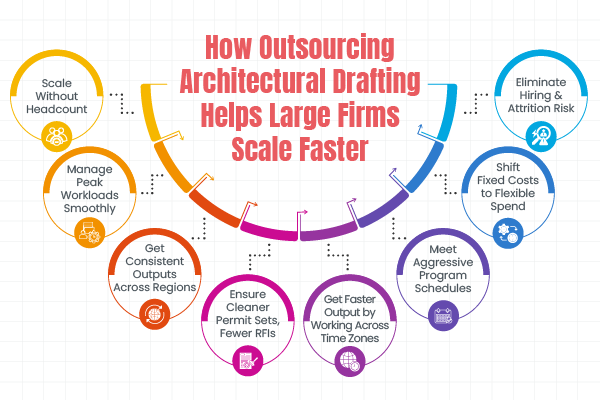
Adding Production Capacity Without Adding Headcount
Large firms often win work faster than they can staff for it. Outsourcing architectural drafting allows you to instantly increase production capacity without hiring, onboarding, or long-term commitments. You gain access to trained drafting teams who align with your standards, letting internal leaders stay focused on design intent, coordination, and client delivery rather than staffing constraints.
-
Handling Peak Workloads Without Burning Out Core Teams
Project timelines are rarely linear. Deadlines stack, submissions overlap, and internal teams stretch thin. Outsourcing helps absorb peak workloads without pushing in-house teams into overtime cycles that lead to errors and burnout. It creates breathing room during high-pressure phases while keeping senior staff productive, motivated, and focused on higher-value project decisions.
-
Standardized Outputs Across Regions and Project Types
AEC enterprise companies operating across multiple regions often struggle with drawing inconsistencies. Outsourcing partners work from defined templates, standards, and QA frameworks, ensuring uniform outputs regardless of location or project type. This consistency simplifies reviews, accelerates approvals, and reinforces your brand’s technical quality across offices, clients, and jurisdictions.
-
Fewer Errors, Fewer RFIs, and Cleaner Permit Sets
Overloaded drafting teams increase the risk of missed dimensions, coordination gaps, and code issues. Dedicated outsourcing teams follow structured QA/QC workflows, reducing downstream RFIs and resubmissions. Cleaner permit sets mean faster approvals, fewer site questions, and less rework during construction, protecting both schedules and margins on large-scale projects.
-
Parallel Production Across Time Zones
Global delivery enables true follow-the-sun production. While your internal team signs off for the day, outsourced teams continue drafting, redlining, and updating models. This parallel workflow shortens turnaround cycles, accelerates submissions, and keeps projects moving continuously- an advantage that becomes critical on fast-track, multi-building, or deadline-driven programs.
-
Meeting Aggressive Deadlines on High-Volume Programs
Large projects demand speed without compromising accuracy. Outsourcing allows multiple packages- plans, sections, details, and revisions- to progress simultaneously instead of sequentially. This parallelization helps firms meet aggressive deadlines for permit submissions, phased releases, and client milestones, even when multiple projects are running concurrently.
-
Converting Fixed Staffing Costs into Flexible Production Costs
Maintaining large in-house teams creates fixed costs that don’t always align with workload fluctuations. Outsourcing transforms drafting into a variable, scalable expense. Firms pay for production when they need it and scale down when they don’t, improving financial predictability while preserving the ability to respond quickly to new project wins.
-
Avoiding Hiring, Training, and Attrition Risks
84% of AEC firms in the US are reporting challenges in hiring skilled new employees. Recruiting skilled drafters takes time and retaining them is becoming increasingly difficult. Outsourcing eliminates recruitment delays, training investments, and the disruption caused by attrition. Enterprise companies gain immediate access to experienced professionals who are already production-ready, reducing operational risk while ensuring continuity across long-term and multi-phase projects.
4. Choosing the Right Outsourcing Partner for Large Architecture Firms
Outsourcing success at the enterprise level depends less on pricing and more on predictability, control, and long-term alignment. The right partner should feel like an extension of your internal team, not a disconnected vendor.
Outsourcing success at the enterprise level depends less on pricing and more on predictability, control, and long-term alignment. The right partner should feel like an extension of your internal team, not a disconnected vendor.
-
Why Enterprise Experience Matters More Than Low Cost
- Complexity over volume: Enterprise projects involve phased submissions, multiple stakeholders, layered approvals, and strict coordination- experience here is non-negotiable.
-
- Risk exposure is higher: Errors on large programs lead to costly RFIs, schedule delays, and reputational impact, outweighing short-term cost savings.
-
- Understanding of governance: Enterprise partners know how to work within BEPs, QA matrices, VMS systems, and compliance-heavy environments.
-
- Scalability without chaos: Proven partners can ramp teams up or down without disrupting workflows or quality.
-
- Long-term partnership mindset: Experienced firms focus on repeatability, standardization, and continuous improvement, not transactional delivery.
-
What to Look for in Processes, QA, and Communication
- Documented, repeatable workflows aligned to enterprise delivery models and multi-office coordination
-
- Multi-stage QA/QC processes with internal checks before submissions reach your team
-
- Clear escalation paths for design conflicts, scope changes, and deadline risks
-
- Dedicated account and project managers who understand your standards and decision hierarchy
-
- Defined SLAs for turnaround times, revisions, and urgent deliverables
-
- Tool and platform compatibility with your CAD/BIM stack, CDEs, and collaboration tools
-
- Secure data handling backed by ISO certifications, access controls, and NDAs
-
- Transparent communication cadence with structured updates, dashboards, and review checkpoints
5. The Best Engagement Models for Large Architecture Practices
- Project-Based, Retainer, or Staff Augmentation- What Works Best?
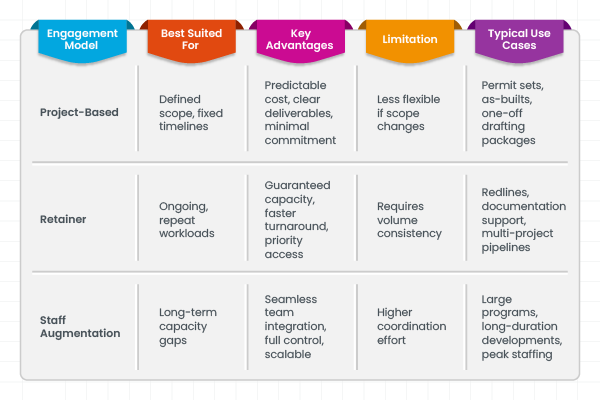
Leading architectural outsourcing companies like Gsource Technologies offer different engagement models, as there’s no one-size-fits-all answer to which one an enterprise company may need. Each engagement model solves a different business need.
- Project-based outsourcing works best for clearly defined scopes, one-off projects, or deadline-driven deliverables where costs and timelines must be locked upfront.
- Retainer models suit firms with steady, predictable drafting volumes that need consistent support without repeated onboarding and estimation cycles.
- Staff augmentation is ideal when you need long-term capacity that integrates directly into your team, tools, and standards, almost like an extension of your in-house staff.
The right choice depends on workload consistency, internal team capacity, project complexity, and how much day-to-day control you want over production.
- Mixing Models Across Portfolios for Maximum Flexibility
Large architecture firms rarely rely on a single engagement model- and for good reason. Mixing project-based, retainer, and staff augmentation models across portfolios allows teams to stay flexible as workloads shift.
Firms can use project-based support for spikes, retainers for steady documentation needs, and augmented staff for long-term programs. This hybrid approach balances cost control, capacity, and delivery certainty without overcommitting internal resources.
6. Is Outsourcing Architectural Drafting Right for Your Enterprise Company in 2026?
Outsourcing isn’t just about saving costs anymore- it’s about staying agile as project volumes, speed expectations, and coordination demands increase.
Signs Your Company Is Ready
- Your in-house team is constantly stretched during peak workloads
- Deadlines are getting tighter, but hiring isn’t scaling fast enough
- Senior designers spend too much time on production work
- You’re handling multi-location or fast-track programs
- Rework, RFIs, or permit comments are slowing projects down
If two or more feel familiar, outsourcing can add real value.
How to Start Without Disrupting Ongoing Projects
- Begin with a pilot project or non-critical package
- Share clear standards, templates, and QA expectations upfront
- Choose a partner who integrates into your workflows, not around them
- Start small, review outcomes, then scale gradually
Done right, outsourcing with a trusted partner like Gsource Technologies strengthens delivery without disrupting momentum.
7. FAQs
How does outsourcing architectural drafting help large architecture firms scale faster?
Outsourcing allows large firms to add production capacity instantly without hiring, training, or expanding internal teams. Gsource enables parallel drafting across projects, helping AEC enterprise companies meet aggressive timelines while maintaining consistency and quality.
What types of architectural drafting work do large firms typically outsource to Gsource?
Enterprise clients partner with Gsource for production-heavy tasks such as construction documentation, permit sets, redlines, as-builts, CAD conversions, and BIM-based drafting, freeing internal teams to focus on design leadership and coordination.
How does Gsource maintain consistency across multiple projects and offices?
Gsource works directly within your CAD standards, templates, layer conventions, and QA checklists. This ensures uniform outputs across regions, project types, and teams, critical for large firms managing distributed portfolios.
Can outsourcing work alongside our in-house drafting and design teams?
Yes. Gsource operates as an extension of your internal team, aligning with your workflows, review cycles, and communication protocols. Many large firms use a hybrid model, keeping design in-house while outsourcing production drafting.
Does Gsource offer retainer models for ongoing support?
Yes, we provide flexible retainer and dedicated team models for long-term, predictable, and scalable production support, ideal for firms with continuous project pipelines or portfolio-based work.
How does Gsource integrate with VMS platforms like Coupa or Ariba?
Gsource supports onboarding and compliance within enterprise VMS platforms, including Coupa and Ariba, and works within your procurement, approval, and invoicing workflows to ensure seamless engagement.
How does Gsource ensure quality and reduce rework for enterprise clients?
Our ISO 9001–certified QA/QC process includes multi-stage reviews, client-specific checklists, and structured feedback loops. This helps large firms reduce drafting errors, RFIs, and permit resubmissions across complex programs.
Can Gsource handle multiple concurrent projects across different time zones?
Absolutely. Gsource’s global delivery model enables parallel production across time zones, allowing enterprise clients to accelerate turnaround times and maintain progress even during peak workloads.
How does outsourcing with Gsource improve cost control for large firms?
Outsourcing converts fixed staffing costs into flexible production costs. Large firms reduce hiring risks, overtime, and idle capacity while gaining predictable pricing and the ability to scale up or down as needed.
Is outsourcing architectural drafting secure for large, high-value projects?
Yes. Gsource follows ISO 27001–certified data security practices, secure access controls, and NDAs to protect sensitive drawings and project information, meeting enterprise-level compliance and confidentiality requirements.
Pavan Mulik is the Vice President of Operations at Gsource Technologies and also serves as Account Manager for Structural and Mechanical Design. With extensive expertise in civil engineering, land surveying, and BIM, he excels at managing complex workflows and driving cross-functional collaboration. His strategic approach ensures smooth project execution at any scale. Outside work, he enjoys exploring landscapes and architectural marvels for inspiration.
Read More