4 Hidden Costs of Not Outsourcing Architectural Work


1. The AEC Industry in 2026
2. Hidden Operational Costs Architecture Firms Often Overlook
3. Myths Surrounding Architectural Outsourcing
4. Architectural Outsourcing Strategy for Large Firms
5. Conclusion
6. FAQs
1. The AEC Industry in 2026
In 2026, the AEC industry looks very different from even a few years ago. Design teams are more digital, more distributed, and under constant pressure to deliver faster. Global spending on AEC software is expected to cross $12 billion in 2026, fueled by cloud platforms, automation, and BIM adoption. In the U.S., nearly 62% of firms are ramping up their use of digital tools, and they have moved from “nice to have” to standard practice, with over two-thirds of architecture firms using them daily.
Simply put, speed, accuracy, and scalability are no longer competitive advantages-they’re the baseline.
2. 4 Hidden Operational Costs Architecture Firms Often Overlook
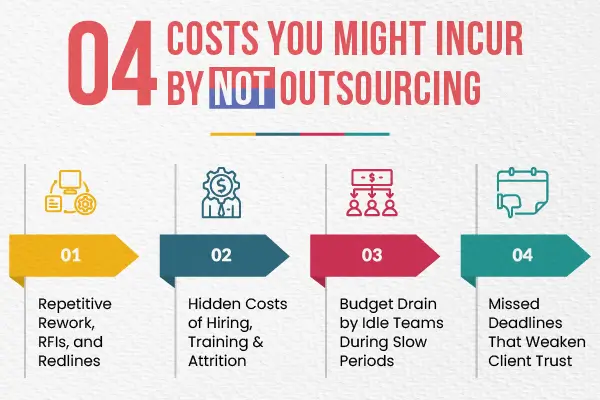
When project deadlines stack up, in-house teams stretch thin. Overtime pay, burnout, rushed decisions, and quality slips quietly inflate costs. Architecture firms often underestimate how much internal overload impacts productivity, delivery speed, and long-term staff retention, especially during seasonal or program-based workload spikes. Here are some problems your company can face by choosing not to outsource architectural services.
-
Rework, RFIs, and Redlines That Keep Coming Back
Small drafting inconsistencies turn into big downstream issues. Inaccurate construction documentation leads to RFIs, repeated redlines, and coordination gaps that drain time and margins. For mid-sized and large firms managing complex projects, these hidden rework costs add up fast and directly impact project profitability and client trust.
-
The True Price of Hiring, Training, and Losing Skilled Talent
Hiring experienced architectural drafters isn’t quick or cheap. Recruiting, onboarding, software training, and inevitable attrition create ongoing expenses. When trained staff leave mid-project, firms absorb both sunk costs and schedule delays. This cycle often costs far more than leadership initially anticipates.
-
Underused Teams During Slow Periods Still Cost You
When workloads dip, fixed payroll doesn’t. Salaries, benefits, licenses, and infrastructure costs continue regardless of billable demand. Many mid-sized and large architecture firms overlook how unused internal capacity quietly erodes margins during slower phases between major project wins.
-
Missed Deadlines That Affect Client Confidence and Repeat Work
Delayed submissions don’t just impact schedules- they affect reputation. When internal teams struggle to keep up, missed deadlines can strain client relationships and reduce repeat opportunities. For enterprise architecture firms, these indirect costs often outweigh the visible project overruns.
3. Common Myths Surrounding Architectural Outsourcing
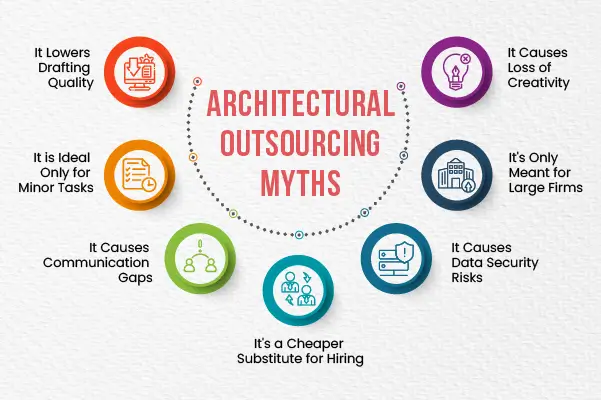
Architectural outsourcing still comes with its fair share of myths. If you or someone in leadership has ever said any of the following, this section is for you. Let’s break down the most common misconceptions and clear up what outsourcing really looks like today.
-
“Outsourcing Will Lower Our Drawing Quality, Right?”
Quality depends on process, not geography. The right outsourcing partner follows your CAD standards, QA/QC checklists, and BIM execution plans. In many cases, outsourced teams catch issues earlier, reduce redlines, and deliver cleaner permit sets than overstretched in-house teams racing against deadlines.
-
“Outsourcing Is Only for Low-Risk, Minor Tasks”
This myth doesn’t hold up anymore. Today, firms outsource architectural services like full SD, DD, CD sets, BIM models, and as-builts for complex projects. With the right partner like Gsource Technologies, outsourcing supports core production, and not just overflow work, without compromising design intent or coordination quality.
-
“We’ll Spend Half Our Time Explaining Things Again”
Modern outsourcing doesn’t mean endless back-and-forth. With clear scopes, shared BIM models, and regular check-ins, communication often improves. Many firms find fewer interruptions, clearer documentation, and more predictable updates, especially when time zones allow overnight progress without constant meetings.
-
“It’s Just a Cheaper Substitute for Hiring”
Cost savings are only part of the story; Outsourcing gives flexibility, scalability, and speed without long-term commitments. Firms use it to manage peaks, protect margins, and meet aggressive timelines- not just to cut costs, but to run leaner and smarter operations.
-
“What About Data Security and IP Risks?”
A valid concern- but a solvable one. Established architectural outsourcing firms like Gsource follow ISO-certified security processes, NDAs, access controls, and secure file systems. In many cases, their data handling protocols are more structured than internal setups stretched across multiple teams and tools.
-
“We’re Not Big Enough to Outsource Yet”
This, of course, can be heard in small and mid-sized firms. But here’s the truth- outsourcing isn’t reserved for global firms. Mid-sized architecture practices often benefit the most. It helps them scale like larger firms, bid competitively, and take on bigger projects without the risk, cost, and complexity of permanently expanding internal teams.
-
“External Teams Won’t Match Our Creativity”
Outsourcing architectural work doesn’t replace your design thinking; it supports it. By handling production-heavy tasks, outsourced teams free your architects to focus on concepts, problem-solving, and client engagement. The result? More time for creativity, not less.
4. Architectural Outsourcing Strategy for Large Firms
For large architecture firms, outsourcing works best when it’s approached as a strategic extension of the core team, not a last-minute fix. The goal of outsourcing isn’t just to reduce costs; it’s to protect timelines, maintain quality, and keep senior teams focused on high-value design and client work.
A smart architectural outsourcing strategy starts with clearly defined scopes. Tasks like construction documentation, permit sets, BIM modeling, CAD conversion, and as-builts are ideal for outsourcing because they’re process-driven and repeatable. This allows internal teams to stay focused on concept design, coordination, and client leadership.
Key elements of a successful strategy include:
- Standardized workflows and templates to ensure consistent outputs across projects
- Dedicated or retainer-based teams for predictable capacity during peak workloads
- Clear communication protocols with weekly check-ins and milestone tracking
- Strong QA/QC processes aligned with your internal standards
- Secure data handling and version control for enterprise-level projects
When executed well, architectural outsourcing becomes a long-term growth lever- helping large firms scale faster, deliver cleaner permit sets, and meet aggressive deadlines without burning out core teams.
5. conclusion
Not outsourcing architectural work doesn’t always show up as a line item in your budget- but it shows up everywhere else. In missed deadlines, overworked teams, repeated revisions, and opportunities quietly slipping away. While many firms focus on visible costs, it’s these hidden inefficiencies that slowly drain time, margins, and momentum.
Outsourcing isn’t about replacing your core team. It’s about supporting them when workloads spike, deadlines tighten, and expectations rise. The right outsourcing partner helps you scale without stress, maintain quality without burnout, and deliver faster without cutting corners.
In the current AEC landscape, agility matters as much as talent. Firms that plan ahead, delegate strategically, and build flexible production capacity stay competitive, especially when the pressure is on.
The real question isn’t whether you can afford to outsource architectural services. It’s whether you can afford not to.
6. FAQs
What are the hidden costs of in-house drafting teams?
Beyond salaries, firms absorb costs for hiring, training, software licenses, idle capacity, rework, and overtime- expenses that quietly erode project margins.
Why do in-house architectural teams struggle to scale?
Headcount can’t expand or contract fast enough to match fluctuating workloads, leading to burnout during peaks and underutilization during slow periods.
Is outsourcing architectural drafting worth it?
Yes. When done right with a reliable partner like Gsource Technologies, outsourcing adds flexible capacity, reduces turnaround time, and lowers operational risk without compromising quality or control.
How do large architecture firms manage drafting workload?
They combine core in-house teams with trusted outsourcing partners to handle production-heavy tasks and respond quickly to deadline-driven demand spikes.
What’s the cost comparison between in-house and outsourced drafting?
In-house drafting often costs 30-50% more annually when overhead is included, while outsourced models convert fixed staffing costs into predictable, project-based spend.
Suraj is the Senior Principal Architect at Gsource Technologies, leading high-level architectural strategy, design development, and multidisciplinary coordination across large-scale projects. With deep expertise in planning, building systems, and integrated project delivery, Suraj combines creative vision with technical precision to drive design excellence. He excels in guiding teams through complex architectural challenges, ensuring code compliance, design intent clarity, and seamless alignment with client goals. Outside of work, he enjoys sketching and draws inspiration from understanding how built environments shape human experiences.
Read More